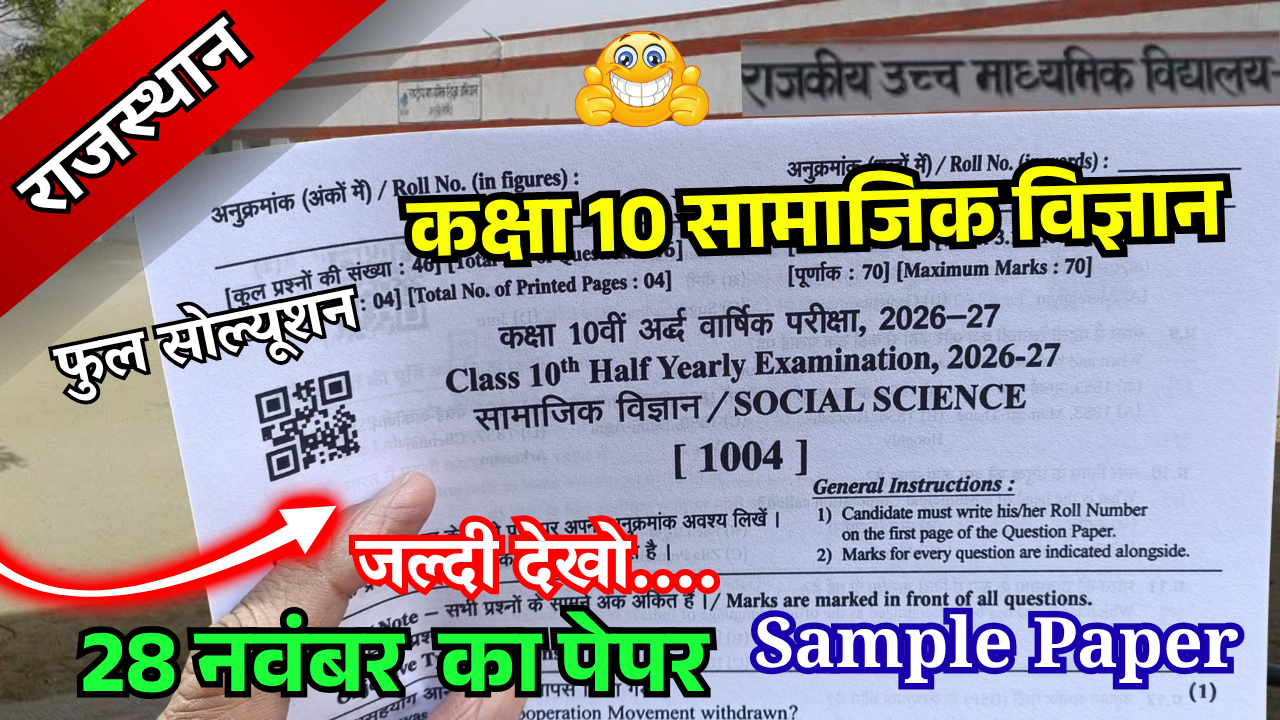
RBSE Class 10th Social Science Half Yearly Question Paper 2026-27 PDF | Complete Question Paper & Solution | कक्षा 10वीं सामाजिक विज्ञान अर्द्धवार्षिक पेपर हल
कक्षा 10वीं अर्द्धवार्षिक परीक्षा, 2026-27
Class 10th Half Yearly Examination, 2026-27
SAMPLE PAPER FOR PRACTICE ONLY
राजस्थान बोर्ड / RBSE – सामाजिक विज्ञान / SOCIAL SCIENCE
प्रश्नपत्र कोड / Paper Code: 1004
| विवरण | जानकारी |
|---|---|
| कुल प्रश्नों की संख्या / Total No. of Questions | 46 |
| कुल मुद्रित पृष्ठ / Total No. of Printed Pages | 04 |
| समय / Time | 3 घंटे 15 मिनट / 3.15 Hours |
| पूर्णांक / Maximum Marks | 70 |
सामान्य अनुदेश / General Instructions
- परीक्षार्थी प्रश्न-पत्र के पहले पृष्ठ पर अपना अनुक्रमांक अवश्य लिखें।
Candidate must write his/her Roll Number on the first page of the Question Paper. - प्रत्येक प्रश्न के सामने उसका अंक भार अंकित है।
Marks for every question are indicated alongside.
नोट / Note: सभी प्रश्नों के सामने अंक अंकित हैं।
Marks are marked in front of all questions.
वस्तुनिष्ठ प्रश्न / Objective Type Questions (1×18=18)
प्र.1 असहयोग आन्दोलन कब वापस लिया गया? (1)
When was the Non-Cooperation Movement withdrawn?
(अ) 1920
(ब) 1922
(स) 1925
(द) 1930
(A) 1920
(B) 1922
(C) 1925
(D) 1930
प्र.2 स्पिनिंग जेनी मशीन का आविष्कार किसने किया था? (1)
Who invented the Spinning Jenny machine?
(अ) जेम्स वाट
(ब) जेम्स हरग्रीव्ज
(स) रिचर्ड आर्कराइट
(द) मैथ्यू बोल्टन
(A) James Watt
(B) James Hargreaves
(C) Richard Arkwright
(D) Matthew Boulton
प्र.3 ‘अमर जीवन’ नामक आत्मकथा किसने लिखी थी? (1)
Who wrote the autobiography named ‘Amar Jiban’?
(अ) पंडिता रमाबाई
(ब) ताराबाई शिंदे
(स) रससुंदरी देवी
(द) कैलाशबासिनी देवी
(A) Pandita Ramabai
(B) Tarabai Shinde
(C) Rashsundari Debi
(D) Kailashbashini Debi
प्र.4 पवन ऊर्जा किस प्रकार का संसाधन है? (1)
What type of resource is wind energy?
(अ) नवीकरणीय
(ब) अनवीकरणीय
(स) जैव
(द) मानव निर्मित
(A) Renewable
(B) Non-renewable
(C) Biotic
(D) Man-made
प्र.5 सरिस्का बाघ रिजर्व किस राज्य में स्थित है? (1)
In which state is Sariska Tiger Reserve located?
(अ) मध्य प्रदेश
(ब) राजस्थान
(स) उत्तराखंड
(द) असम
(A) Madhya Pradesh
(B) Rajasthan
(C) Uttarakhand
(D) Assam
प्र.6 भाखड़ा नांगल परियोजना किस नदी पर निर्मित है? (1)
On which river is the Bhakra Nangal Project built?
(अ) व्यास नदी
(ब) सतलुज नदी
(स) नर्मदा नदी
(द) दामोदर नदी
(A) Beas River
(B) Sutlej River
(C) Narmada River
(D) Damodar River
प्र.7 निम्नलिखित में से कौनसी एक फलीदार फसल है? (1)
Which of the following is a leguminous crop?
(अ) दालें
(ब) ज्वार
(स) मोटे अनाज
(द) तिल
(A) Pulses
(B) Jowar
(C) Millets
(D) Sesamum
प्र.8 निम्न में से कौनसा उद्योग चूना पत्थर को कच्चे माल के रूप में प्रयुक्त करता है? (1)
Which of the following industries uses limestone as a raw material?
(अ) एल्युमिनियम
(ब) सीमेंट
(स) चीनी
(द) पटसन
(A) Aluminium
(B) Cement
(C) Sugar
(D) Jute
प्र.9 भारत में पहली रेलगाड़ी कब और कहाँ से कहाँ तक चलाई गई? (1)
When and between which stations did the first train run in India?
(अ) 1853, मुम्बई-थाणे
(ब) 1854, हावड़ा-हुगली
(स) 1850, दिल्ली-आगरा
(द) 1857, चेन्नई-अर्कोणम
(A) 1853, Mumbai-Thane
(B) 1854, Howrah-Hooghly
(C) 1850, Delhi-Agra
(D) 1857, Chennai-Arkonam
प्र.10 नगर निगम के प्रमुख को क्या कहा जाता है? (1)
What is the head of a Municipal Corporation called?
(अ) सरपंच
(ब) मेयर (महापौर)
(स) जिला प्रमुख
(द) प्रधान
(A) Sarpanch
(B) Mayor
(C) Zila Pramukh
(D) Pradhan
प्र.11 भारत की राजभाषा के रूप में किसे मान्यता दी गई है? (1)
Which language has been recognized as the official language of India?
(अ) अंग्रेजी
(ब) संस्कृत
(स) हिन्दी
(द) उर्दू
(A) English
(B) Sanskrit
(C) Hindi
(D) Urdu
प्र.12 बहुजन समाज पार्टी (BSP) के संस्थापक कौन थे? (1)
Who was the founder of Bahujan Samaj Party (BSP)?
(अ) कांशीराम
(ब) ज्योतिबा फुले
(स) बी.आर. अम्बेडकर
(द) साहू महाराज
(A) Kanshi Ram
(B) Jyotiba Phule
(C) B.R. Ambedkar
(D) Sahu Maharaj
प्र.13 भारतीय संविधान के किस अनुच्छेद के तहत अस्पृश्यता का अंत किया गया है? (1)
Under which Article of the Indian Constitution has untouchability been abolished?
(अ) अनुच्छेद 14
(ब) अनुच्छेद 15
(स) अनुच्छेद 17
(द) अनुच्छेद 21
(A) Article 14
(B) Article 15
(C) Article 17
(D) Article 21
प्र.14 बेल्जियम किस महाद्वीप का एक छोटा-सा देश है? (1)
Belgium is a small country of which continent?
(अ) एशिया
(ब) यूरोप
(स) अफ्रीका
(द) उत्तरी अमेरिका
(A) Asia
(B) Europe
(C) Africa
(D) North America
प्र.15 मानव विकास सूचकांक (HDI) किस संस्था द्वारा प्रकाशित किया जाता है? (1)
Which organization publishes the Human Development Index (HDI)?
(अ) विश्व बैंक
(ब) यू.एन.डी.पी.
(स) विश्व व्यापार संगठन
(द) अन्तर्राष्ट्रीय मुद्रा कोष
(A) World Bank
(B) UNDP
(C) WTO
(D) IMF
प्र.16 निम्न में से कौनसी गतिविधि तृतीयक क्षेत्रक के अंतर्गत आती है? (1)
Which of the following activities falls under the Tertiary Sector?
(अ) मछली पकड़ना
(ब) कपड़ा बुनना
(स) बैंकिंग व संचार
(द) खनन
(A) Fishing
(B) Weaving cloth
(C) Banking & Communication
(D) Mining
प्र.17 भारत में करेंसी नोट जारी करने का एकाधिकार किस बैंक को प्राप्त है? (1)
Which bank has the sole authority to issue currency notes in India?
(अ) भारतीय स्टेट बैंक
(ब) भारतीय रिजर्व बैंक
(स) पंजाब नेशनल बैंक
(द) बैंक ऑफ बड़ौदा
(A) State Bank of India
(B) Reserve Bank of India
(C) Punjab National Bank
(D) Bank of Baroda
प्र.18 भारत में राष्ट्रीय उपभोक्ता दिवस प्रतिवर्ष कब मनाया जाता है? (1)
When is National Consumers Day observed every year in India?
(अ) 15 मार्च
(ब) 24 दिसम्बर
(स) 10 दिसम्बर
(द) 5 जून
(A) 15 March
(B) 24 December
(C) 10 December
(D) 5 June
रिक्त स्थानों की पूर्ति करें / Fill in the Blanks (1×6=6)
प्र.19 1929 के लाहौर कांग्रेस अधिवेशन की अध्यक्षता ________ ने की थी। (1)
The Lahore Congress Session of 1929 was presided over by ________.
प्र.20 भारत में पहली कपड़ा मिल सन् 1854 में ________ में स्थापित हुई। (1)
The first cotton mill in India was set up in 1854 at ________.
प्र.21 काली मृदा ________ की खेती के लिए सर्वाधिक उपयुक्त मानी जाती है। (1)
Black soil is considered ideal for growing ________.
प्र.22 बाँधों को आधुनिक भारत के मंदिर ________ ने कहा था। (1)
Dams were proclaimed as the temples of modern India by ________.
प्र.23 विश्व का सबसे बड़ा सघन जनसंख्या वाला देश ________ है। (1)
The most populous country in the world is ________.
प्र.24 भारत में ________ दलीय व्यवस्था प्रचलित है। (1)
________ party system is prevalent in India.
अति लघुत्तरात्मक प्रश्न / Very Short Type Questions (1×6=6)
प्र.25 ‘पंचांग’ (Almanac) से आप क्या समझते हैं? (1)
What do you understand by ‘Almanac’?
प्र.26 सत्ता की साझेदारी क्यों आवश्यक है? कोई एक कारण लिखिए। (1)
Why is power sharing desirable? Write any one reason.
प्र.27 भारतीय राष्ट्रीय कांग्रेस की स्थापना कब और किसने की? (1)
When and by whom was the Indian National Congress founded?
प्र.28 पारदर्शिता से क्या तात्पर्य है? (1)
What is meant by transparency?
प्र.29 वस्तु विनिमय प्रणाली की एक प्रमुख कठिनाई लिखिए। (1)
Write one major limitation of the barter system.
प्र.30 एगमार्क (AGMARK) व आई.एस.आई. (ISI) शब्द किन वस्तुओं की गुणवत्ता प्रमाणित करते हैं? (1)
For which goods do the logos AGMARK and ISI certify quality?
लघुत्तरात्मक प्रश्न / Short Essay Type Questions (2×12=24)
प्र.31 जलियाँवाला बाग हत्याकांड पर संक्षिप्त टिप्पणी लिखिए। (2)
Write a brief note on the Jallianwala Bagh massacre.
प्र.32 मुद्रण संस्कृति ने भारत में राष्ट्रवाद के विकास में किस प्रकार योगदान दिया? (2)
How did print culture assist the growth of nationalism in India?
प्र.33 ‘जॉबर’ कौन थे? नई औद्योगिक व्यवस्था में उनकी क्या भूमिका थी? (2)
Who were ‘Jobbers’? What was their role in the new industrial system?
प्र.34 मृदा अपरदन से क्या आशय है? इसे रोकने के कोई दो उपाय लिखिए। (2)
What is meant by soil erosion? Write any two measures to prevent it.
प्र.35 वर्षा जल संग्रहण के प्रमुख उद्देश्यों को स्पष्ट कीजिए। (2)
Clarify the main objectives of rainwater harvesting.
प्र.36 रोपण कृषि की कोई चार विशेषताएँ लिखिए। (2)
Write any four characteristics of plantation agriculture.
प्र.37 संघीय शासन व्यवस्था की कोई दो प्रमुख विशेषताएँ बताइए। (2)
State any two key features of federalism.
प्र.38 लैंगिक विभाजन से क्या अभिप्राय है? समझाइए। (2)
What is meant by sexual division of labour? Explain.
प्र.39 सतत पोषणीय विकास से आप क्या समझते हैं? यह क्यों आवश्यक है? (2)
What do you understand by sustainable development? Why is it essential?
प्र.40 संगठित एवं असंगठित क्षेत्रक में कोई दो अन्तर स्पष्ट कीजिए। (2)
Clarify any two differences between Organised and Unorganised sectors.
प्र.41 मनरेगा (MGNREGA) 2005 के प्रमुख उद्देश्यों का वर्णन कीजिए। (2)
Describe the main objectives of MGNREGA 2005.
प्र.42 स्वयं सहायता समूह (SHG) ग्रामीण निर्धनों की किस प्रकार सहायता करते हैं? (2)
How do Self-Help Groups (SHGs) help the rural poor?
निबंधात्मक प्रश्न / Essay Type Questions (4×4=16)
प्र.43 जर्मनी के एकीकरण की प्रक्रिया का विस्तार से वर्णन कीजिए। (4)
Describe in detail the process of unification of Germany.
अथवा / OR
इटली के एकीकरण में कावूर तथा गैरीबाल्डी के योगदान को स्पष्ट कीजिए।
Clarify the contribution of Cavour and Garibaldi in the unification of Italy.
प्र.44 ‘रेशम मार्ग’ (सिल्क रूट) से आप क्या समझते हैं? इसने विश्व को किस प्रकार जोड़ा? (4)
What do you understand by ‘Silk Routes’? How did they link the world?
अथवा / OR
निम्न पर टिप्पणी लिखिए – (A) कॉर्न लॉ (B) अंतर्राष्ट्रीय मुद्रा कोष (IMF)
Comment on the following – (A) Corn Laws (B) International Monetary Fund (IMF).
प्र.45 बहुराष्ट्रीय कम्पनियाँ (MNCs) किस प्रकार विभिन्न देशों में उत्पादन पर नियंत्रण रखती हैं? (4)
How do Multinational Corporations (MNCs) control production across different countries?
अथवा / OR
विदेशी व्यापार विभिन्न देशों के बाजारों के एकीकरण में किस प्रकार सहायक है?
How does foreign trade help in the integration of markets across different countries?
प्र.46 निम्न को भारत के मानचित्र पर अंकित करो। (4)
Mark the following on the Map of India.
(1) रावतभाटा / Rawatbhata
(2) तारापुर / Tarapur
(3) नरोरा / Narora
(4) कलपक्कम / Kalpakkam
(5) काकरापार / Kakrapar
अथवा / OR
भारत के मानचित्र में अंकित करो।
Mark it on the Map of India.
(1) डिगबोई / Digboi
(2) अंकलेश्वर / Ankleshwar
(3) मुम्बई हाई / Mumbai High
(4) नाहरकटिया / Naharkatiya
(5) बसीन / Bassien
संपूर्ण प्रश्नपत्र का हल (Complete Solution)
प्रश्न 1 से 18 – वस्तुनिष्ठ प्रश्नों के सही उत्तर (1×18=18)
प्र.1 असहयोग आन्दोलन कब वापस लिया गया?
उत्तर – (ब) 1922
Answer – (B) 1922
प्र.2 स्पिनिंग जेनी मशीन का आविष्कार किसने किया था?
उत्तर – (ब) जेम्स हरग्रीव्ज
Answer – (B) James Hargreaves
प्र.3 ‘अमर जीवन’ नामक आत्मकथा किसने लिखी थी?
उत्तर – (स) रससुंदरी देवी
Answer – (C) Rashsundari Debi
प्र.4 पवन ऊर्जा किस प्रकार का संसाधन है?
उत्तर – (अ) नवीकरणीय
Answer – (A) Renewable
प्र.5 सरिस्का बाघ रिजर्व किस राज्य में स्थित है?
उत्तर – (ब) राजस्थान
Answer – (B) Rajasthan
प्र.6 भाखड़ा नांगल परियोजना किस नदी पर निर्मित है?
उत्तर – (ब) सतलुज नदी
Answer – (B) Sutlej River
प्र.7 निम्नलिखित में से कौनसी एक फलीदार फसल है?
उत्तर – (अ) दालें
Answer – (A) Pulses
प्र.8 कौनसा उद्योग चूना पत्थर को कच्चे माल के रूप में प्रयुक्त करता है?
उत्तर – (ब) सीमेंट उद्योग
Answer – (B) Cement Industry
प्र.9 भारत में पहली रेलगाड़ी कब और कहाँ से कहाँ तक चलाई गई?
उत्तर – (अ) 1853, मुम्बई से थाणे
Answer – (A) 1853, Mumbai to Thane
प्र.10 नगर निगम के प्रमुख को क्या कहा जाता है?
उत्तर – (ब) मेयर (महापौर)
Answer – (B) Mayor
प्र.11 भारत की राजभाषा के रूप में किसे मान्यता दी गई है?
उत्तर – (स) हिन्दी
Answer – (C) Hindi
प्र.12 बहुजन समाज पार्टी के संस्थापक कौन थे?
उत्तर – (अ) कांशीराम
Answer – (A) Kanshi Ram
प्र.13 अस्पृश्यता का अंत किस अनुच्छेद के तहत किया गया है?
उत्तर – (स) अनुच्छेद 17
Answer – (C) Article 17
प्र.14 बेल्जियम किस महाद्वीप का देश है?
उत्तर – (ब) यूरोप
Answer – (B) Europe
प्र.15 मानव विकास सूचकांक किस संस्था द्वारा प्रकाशित किया जाता है?
उत्तर – (ब) यू.एन.डी.पी. (UNDP)
Answer – (B) UNDP
प्र.16 तृतीयक क्षेत्रक की गतिविधि कौनसी है?
उत्तर – (स) बैंकिंग व संचार
Answer – (C) Banking and Communication
प्र.17 भारत में करेंसी नोट जारी करने का एकाधिकार किस बैंक को प्राप्त है?
उत्तर – (ब) भारतीय रिजर्व बैंक
Answer – (B) Reserve Bank of India
प्र.18 भारत में राष्ट्रीय उपभोक्ता दिवस कब मनाया जाता है?
उत्तर – (ब) 24 दिसम्बर
Answer – (B) 24 December
प्रश्न 19 से 24 – रिक्त स्थानों की पूर्ति (1×6=6)
प्र.19 1929 के लाहौर कांग्रेस अधिवेशन की अध्यक्षता ________ ने की थी।
उत्तर – जवाहरलाल नेहरू
Answer – Jawaharlal Nehru
प्र.20 भारत में पहली कपड़ा मिल सन् 1854 में ________ में स्थापित हुई।
उत्तर – मुम्बई
Answer – Mumbai
प्र.21 काली मृदा ________ की खेती के लिए सर्वाधिक उपयुक्त मानी जाती है।
उत्तर – कपास
Answer – Cotton
प्र.22 बाँधों को आधुनिक भारत के मंदिर ________ ने कहा था।
उत्तर – जवाहरलाल नेहरू
Answer – Jawaharlal Nehru
प्र.23 विश्व का सबसे बड़ा सघन जनसंख्या वाला देश ________ है।
उत्तर – भारत
Answer – India
प्र.24 भारत में ________ दलीय व्यवस्था प्रचलित है।
उत्तर – बहुदलीय
Answer – Multi-party
प्रश्न 25 से 30 – अति लघुत्तरात्मक प्रश्न (1×6=6)
प्र.25 ‘पंचांग’ (Almanac) से आप क्या समझते हैं?
उत्तर – पंचांग एक ऐसी पुस्तक या वार्षिक विवरण है जिसमें तिथियों, दिनों, त्योहारों, महत्वपूर्ण घटनाओं तथा खगोलीय जानकारियों का विवरण दिया जाता है।
Answer – An almanac is a yearly publication containing information about dates, days, festivals, important events and astronomical details.
प्र.26 सत्ता की साझेदारी क्यों आवश्यक है? कोई एक कारण लिखिए।
उत्तर – सत्ता की साझेदारी से समाज के विभिन्न वर्गों को शासन में भागीदारी मिलती है। इससे सामाजिक संघर्ष कम होता है और देश में राजनीतिक स्थिरता बनी रहती है।
Answer – Power sharing gives different sections of society a share in governance. It reduces social conflict and helps maintain political stability.
प्र.27 भारतीय राष्ट्रीय कांग्रेस की स्थापना कब और किसने की?
उत्तर – भारतीय राष्ट्रीय कांग्रेस की स्थापना 1885 में ए. ओ. ह्यूम के प्रयासों से हुई थी। इसका पहला अधिवेशन बम्बई में हुआ था।
Answer – The Indian National Congress was founded in 1885 through the efforts of A.O. Hume. Its first session was held in Bombay.
प्र.28 पारदर्शिता से क्या तात्पर्य है?
उत्तर – पारदर्शिता का अर्थ है कि सरकार के निर्णयों और कार्यों की जानकारी नागरिकों को उपलब्ध हो तथा वे शासन के कामकाज को समझ सकें।
Answer – Transparency means that citizens can obtain information about government decisions and activities and understand how the government functions.
प्र.29 वस्तु विनिमय प्रणाली की एक प्रमुख कठिनाई लिखिए।
उत्तर – वस्तु विनिमय प्रणाली में आवश्यकताओं का दोहरा संयोग होना आवश्यक है। अर्थात दोनों व्यक्तियों को एक-दूसरे की वस्तुओं की आवश्यकता होनी चाहिए।
Answer – A major difficulty of the barter system is the need for double coincidence of wants. Both persons must want what the other has to offer.
प्र.30 एगमार्क (AGMARK) व आई.एस.आई. (ISI) किन वस्तुओं की गुणवत्ता प्रमाणित करते हैं?
उत्तर – AGMARK कृषि उत्पादों की गुणवत्ता प्रमाणित करता है, जबकि ISI चिह्न औद्योगिक एवं निर्मित वस्तुओं की निर्धारित गुणवत्ता और मानकों को प्रमाणित करता है।
Answer – AGMARK certifies the quality of agricultural products, while the ISI mark certifies that industrial and manufactured products meet prescribed quality standards.
प्रश्न 31 से 42 – लघुत्तरात्मक प्रश्न (2×12=24)
प्र.31 जलियाँवाला बाग हत्याकांड पर संक्षिप्त टिप्पणी लिखिए।
उत्तर – 13 अप्रैल 1919 को अमृतसर के जलियाँवाला बाग में रॉलेट एक्ट के विरोध में एक शांतिपूर्ण सभा आयोजित की गई थी। जनरल डायर ने बिना चेतावनी दिए निहत्थी भीड़ पर गोलियाँ चलवा दीं। इस घटना में सैकड़ों लोग मारे गए और अनेक घायल हुए। इस घटना ने पूरे देश में अंग्रेजी शासन के प्रति आक्रोश बढ़ा दिया।
Answer – On 13 April 1919, a peaceful gathering was held at Jallianwala Bagh in Amritsar to protest against the Rowlatt Act. General Dyer ordered firing on the unarmed crowd without warning. Hundreds of people were killed and many were injured. The incident increased anger against British rule throughout India.
प्र.32 मुद्रण संस्कृति ने भारत में राष्ट्रवाद के विकास में किस प्रकार योगदान दिया?
उत्तर –
- समाचार-पत्रों, पुस्तकों और पत्रिकाओं ने देश के लोगों तक राष्ट्रीय विचार पहुँचाए।
- मुद्रण के माध्यम से अंग्रेजी शासन की नीतियों की आलोचना हुई और स्वतंत्रता, समानता तथा एकता की भावना का प्रसार हुआ।
- विभिन्न क्षेत्रों के लोगों को राष्ट्रीय आंदोलन की गतिविधियों की जानकारी मिलने लगी।
Answer –
- Newspapers, books and magazines spread nationalist ideas among people.
- Print media criticised British policies and promoted freedom, equality and unity.
- People in different regions became aware of the activities of the national movement.
प्र.33 ‘जॉबर’ कौन थे? नई औद्योगिक व्यवस्था में उनकी क्या भूमिका थी?
उत्तर – जॉबर वे व्यक्ति थे जिन्हें औद्योगिक मालिक मजदूरों की भर्ती के लिए नियुक्त करते थे। वे गाँवों से मजदूरों को कारखानों में लाते थे और उन्हें काम दिलाने में सहायता करते थे। कई बार वे मजदूरों पर नियंत्रण भी रखते थे।
Answer – Jobbers were people employed by industrialists to recruit workers. They brought workers from villages to factories and helped them find employment. In many cases, they also exercised control over the workers.
प्र.34 मृदा अपरदन से क्या आशय है? इसे रोकने के कोई दो उपाय लिखिए।
उत्तर – जल, वायु या अन्य प्राकृतिक कारणों से मिट्टी की ऊपरी उपजाऊ परत का हट जाना मृदा अपरदन कहलाता है।
इसे रोकने के दो उपाय:
- वृक्षारोपण करना और वनों की कटाई रोकना।
- ढाल वाली भूमि पर सीढ़ीदार खेती तथा समोच्च जुताई करना।
Answer – Soil erosion refers to the removal of the fertile top layer of soil by water, wind or other natural forces.
Two measures to prevent it:
- Planting trees and preventing deforestation.
- Practising terrace farming and contour ploughing on slopes.
प्र.35 वर्षा जल संग्रहण के प्रमुख उद्देश्यों को स्पष्ट कीजिए।
उत्तर –
- वर्षा के पानी को एकत्र करके भविष्य में उपयोग करना।
- भूजल स्तर को बढ़ाना और जल की कमी को दूर करना।
- सूखे के प्रभाव को कम करना तथा जल संसाधनों का संरक्षण करना।
Answer –
- To collect rainwater for future use.
- To increase groundwater levels and reduce water scarcity.
- To reduce the effects of drought and conserve water resources.
प्र.36 रोपण कृषि की कोई चार विशेषताएँ लिखिए।
उत्तर –
- रोपण कृषि में एक ही फसल बड़े क्षेत्र में उगाई जाती है।
- इसमें अधिक पूँजी और श्रमिकों की आवश्यकता होती है।
- आधुनिक तकनीक और वैज्ञानिक तरीकों का उपयोग किया जाता है।
- इसकी उपज का बड़ा भाग व्यापार और उद्योगों के लिए होता है।
Answer –
- A single crop is grown over a large area.
- It requires large amounts of capital and labour.
- Modern technology and scientific methods are used.
- A large part of the produce is meant for trade and industries.
प्र.37 संघीय शासन व्यवस्था की कोई दो प्रमुख विशेषताएँ बताइए।
उत्तर –
- संघीय व्यवस्था में शासन की शक्तियाँ केंद्र सरकार और राज्य सरकारों के बीच संविधान द्वारा बाँटी जाती हैं।
- सरकार के प्रत्येक स्तर के अधिकार और कार्यक्षेत्र संविधान में निर्धारित होते हैं।
Answer –
- In a federal system, powers are divided between the central and state governments by the Constitution.
- The powers and areas of responsibility of each level of government are defined by the Constitution.
प्र.38 लैंगिक विभाजन से क्या अभिप्राय है? समझाइए।
उत्तर – समाज में स्त्री और पुरुष के बीच काम तथा जिम्मेदारियों का बँटवारा लैंगिक विभाजन कहलाता है। परंपरागत रूप से घरेलू कार्यों को महिलाओं का और बाहरी कार्यों को पुरुषों का कार्य माना जाता रहा है। यह विभाजन सामाजिक मान्यताओं पर आधारित होता है।
Answer – Sexual division of labour refers to the division of work and responsibilities between men and women in society. Traditionally, household work has been considered women’s responsibility and outside work men’s responsibility. This division is based on social beliefs.
प्र.39 सतत पोषणीय विकास से आप क्या समझते हैं? यह क्यों आवश्यक है?
उत्तर – सतत पोषणीय विकास वह विकास है जिसमें वर्तमान पीढ़ी की आवश्यकताओं को पूरा करते हुए भविष्य की पीढ़ियों की आवश्यकताओं को पूरा करने की क्षमता से समझौता नहीं किया जाता।
यह आवश्यक है क्योंकि इससे प्राकृतिक संसाधनों का संरक्षण होता है, पर्यावरण संतुलित रहता है और आने वाली पीढ़ियों के लिए संसाधन सुरक्षित रहते हैं।
Answer – Sustainable development means development that meets the needs of the present generation without compromising the ability of future generations to meet their own needs.
It is essential because it conserves natural resources, maintains environmental balance and protects resources for future generations.
प्र.40 संगठित एवं असंगठित क्षेत्रक में कोई दो अन्तर स्पष्ट कीजिए।
उत्तर –
| संगठित क्षेत्रक | असंगठित क्षेत्रक |
|---|---|
| इसमें रोजगार की शर्तें निश्चित होती हैं तथा सरकारी नियमों का पालन किया जाता है। | इसमें रोजगार की शर्तें प्रायः निश्चित नहीं होतीं और नियमों का पालन सीमित होता है। |
| कर्मचारियों को नियमित वेतन, छुट्टी और अन्य सुविधाएँ मिलती हैं। | कर्मचारियों को नियमित वेतन और सामाजिक सुरक्षा की सुविधाएँ प्रायः नहीं मिलतीं। |
Answer –
| Organised Sector | Unorganised Sector |
|---|---|
| Employment conditions are fixed and government rules are followed. | Employment conditions are often uncertain and rules may not be properly followed. |
| Employees generally receive regular wages, leave and other benefits. | Employees often do not receive regular wages or social security benefits. |
प्र.41 मनरेगा (MGNREGA) 2005 के प्रमुख उद्देश्यों का वर्णन कीजिए।
उत्तर –
- ग्रामीण परिवारों को एक वित्तीय वर्ष में कम-से-कम 100 दिनों के मजदूरी रोजगार की गारंटी देना।
- ग्रामीण क्षेत्रों में बेरोजगारी और निर्धनता कम करना।
- जल संरक्षण, सड़क और अन्य उपयोगी ग्रामीण परिसंपत्तियों का निर्माण करना।
Answer –
- To guarantee at least 100 days of wage employment to rural households in a financial year.
- To reduce unemployment and poverty in rural areas.
- To create useful rural assets such as water conservation structures and roads.
प्र.42 स्वयं सहायता समूह (SHG) ग्रामीण निर्धनों की किस प्रकार सहायता करते हैं?
उत्तर –
- स्वयं सहायता समूह के सदस्य नियमित रूप से छोटी-छोटी बचत जमा करते हैं।
- समूह के सदस्य आवश्यकता पड़ने पर जमा धन से कम ब्याज पर ऋण प्राप्त कर सकते हैं।
- ये समूह लोगों को साहूकारों पर निर्भरता कम करने और छोटे व्यवसाय शुरू करने में सहायता करते हैं।
Answer –
- Members of Self-Help Groups regularly save small amounts of money.
- Members can obtain loans from the group at reasonable interest rates when needed.
- These groups reduce dependence on moneylenders and help people start small businesses.
प्रश्न 43 से 46 – निबंधात्मक प्रश्न (4×4=16)
प्र.43 जर्मनी के एकीकरण की प्रक्रिया का विस्तार से वर्णन कीजिए। (4)
उत्तर – जर्मनी का एकीकरण
- 19वीं शताब्दी के प्रारंभ में जर्मनी अनेक छोटे-छोटे राज्यों में बँटा हुआ था। इन राज्यों को एकजुट करने के लिए राष्ट्रवादी भावना का विकास हुआ।
- प्रशा ने जर्मनी के एकीकरण में महत्वपूर्ण भूमिका निभाई। प्रशा का प्रधानमंत्री ऑटो वॉन बिस्मार्क इस कार्य का प्रमुख नेता था।
- बिस्मार्क ने जर्मनी के एकीकरण के लिए सेना और कूटनीति का सहारा लिया। उसने डेनमार्क, ऑस्ट्रिया और फ्रांस के विरुद्ध युद्ध किए।
- इन युद्धों में प्रशा की विजय के बाद जर्मन राज्यों का एकीकरण संभव हुआ।
- जनवरी 1871 में वर्साय के महल में प्रशा के राजा विलियम प्रथम को जर्मन सम्राट घोषित किया गया।
इस प्रकार बिस्मार्क के नेतृत्व में जर्मनी का एकीकरण पूरा हुआ।
Describe in detail the process of unification of Germany.
Answer – Unification of Germany
- In the early nineteenth century, Germany was divided into many small states. Nationalist feelings developed to unite these states.
- Prussia played an important role in the unification of Germany. Its Chief Minister, Otto von Bismarck, led the process.
- Bismarck used the army and diplomacy to achieve unification. He fought wars against Denmark, Austria and France.
- After Prussia’s victories in these wars, the German states were united.
- In January 1871, King William I of Prussia was proclaimed German Emperor at the Palace of Versailles.
Thus, Germany was unified under the leadership of Bismarck.
अथवा / OR
इटली के एकीकरण में कावूर तथा गैरीबाल्डी के योगदान को स्पष्ट कीजिए।
उत्तर –
- काउंट कैमिलो डी कावूर: कावूर सार्डिनिया-पीडमॉण्ट का मुख्यमंत्री था। उसने कूटनीति और युद्ध के माध्यम से इटली के एकीकरण का मार्ग तैयार किया। उसने फ्रांस की सहायता से ऑस्ट्रिया को पराजित करने में महत्वपूर्ण भूमिका निभाई।
- ज्यूसेपे गैरीबाल्डी: गैरीबाल्डी एक क्रांतिकारी नेता था। उसने अपने स्वयंसेवकों की सेना, जिसे रेड शर्ट्स कहा जाता था, के साथ दक्षिणी इटली और सिसिली पर विजय प्राप्त की।
- गैरीबाल्डी ने जीते हुए क्षेत्रों को राजा विक्टर इमैनुएल द्वितीय को सौंप दिया।
- कावूर की कूटनीति और गैरीबाल्डी के सैन्य योगदान से इटली के एकीकरण की प्रक्रिया पूरी हुई।
Clarify the contribution of Cavour and Garibaldi in the unification of Italy.
Answer –
- Count Camillo de Cavour: Cavour was the Chief Minister of Sardinia-Piedmont. He used diplomacy and war to prepare the way for Italian unification. He played an important role in defeating Austria with French support.
- Giuseppe Garibaldi: Garibaldi was a revolutionary leader. With his volunteer army, known as the Red Shirts, he conquered Sicily and southern Italy.
- Garibaldi handed over the conquered territories to King Victor Emmanuel II.
- The diplomatic efforts of Cavour and the military contribution of Garibaldi helped complete the unification of Italy.
प्र.44 ‘रेशम मार्ग’ (सिल्क रूट) से आप क्या समझते हैं? इसने विश्व को किस प्रकार जोड़ा? (4)
उत्तर – रेशम मार्ग प्राचीन व्यापारिक मार्गों का एक समूह था, जो एशिया को यूरोप और उत्तरी अफ्रीका के विभिन्न भागों से जोड़ता था। इन मार्गों से चीन का रेशम, मसाले, वस्त्र और अन्य वस्तुओं का व्यापार होता था।
रेशम मार्ग ने विश्व को निम्न प्रकार से जोड़ा:
- इस मार्ग से व्यापारी एक देश से दूसरे देश तक वस्तुओं का आदान-प्रदान करते थे।
- चीन, भारत, मध्य एशिया और यूरोप के बीच व्यापारिक संबंध विकसित हुए।
- धर्म, संस्कृति, भाषा और विचारों का प्रसार हुआ।
- इस मार्ग से तकनीक, ज्ञान और नई वस्तुएँ विभिन्न क्षेत्रों तक पहुँचीं।
इस प्रकार रेशम मार्ग ने प्राचीन विश्व में व्यापार और सांस्कृतिक संपर्क को बढ़ावा दिया।
What do you understand by Silk Routes? How did they link the world?
Answer – The Silk Routes were a network of ancient trade routes that connected Asia with different parts of Europe and North Africa. Chinese silk, spices, textiles and other goods were traded through these routes.
The Silk Routes connected the world in the following ways:
- Traders exchanged goods between different countries.
- Trade relations developed among China, India, Central Asia and Europe.
- Religions, cultures, languages and ideas spread through these routes.
- Technology, knowledge and new products reached different regions.
Thus, the Silk Routes promoted trade and cultural contact in the ancient world.
अथवा / OR
निम्न पर टिप्पणी लिखिए – (A) कॉर्न लॉ (B) अंतर्राष्ट्रीय मुद्रा कोष (IMF)
उत्तर –
(A) कॉर्न लॉ (Corn Laws):
कॉर्न लॉ ब्रिटेन में बनाए गए ऐसे कानून थे जिनके माध्यम से विदेशों से अनाज के आयात पर प्रतिबंध या भारी शुल्क लगाया जाता था। इन कानूनों का उद्देश्य ब्रिटेन के स्थानीय अनाज उत्पादकों के हितों की रक्षा करना था। इनके हटने से विदेशों से सस्ता अनाज आने लगा और खाद्य पदार्थों की कीमतों में कमी आई।
(B) अंतर्राष्ट्रीय मुद्रा कोष (IMF):
अंतर्राष्ट्रीय मुद्रा कोष की स्थापना 1944 में ब्रेटन वुड्स सम्मेलन के दौरान हुई थी। इसका उद्देश्य अंतर्राष्ट्रीय मौद्रिक सहयोग बढ़ाना, विनिमय दरों में स्थिरता बनाए रखना और भुगतान संतुलन की समस्या से जूझ रहे देशों को वित्तीय सहायता देना है।
Comment on the following – (A) Corn Laws (B) International Monetary Fund (IMF).
Answer –
(A) Corn Laws:
The Corn Laws were laws introduced in Britain to restrict or heavily tax the import of foreign grain. Their purpose was to protect the interests of local grain producers. After these laws were abolished, cheaper grain could be imported and food prices fell.
(B) International Monetary Fund (IMF):
The International Monetary Fund was established in 1944 during the Bretton Woods Conference. Its objectives include promoting international monetary cooperation, maintaining exchange rate stability and providing financial assistance to countries facing balance of payments problems.
प्र.45 बहुराष्ट्रीय कम्पनियाँ (MNCs) किस प्रकार विभिन्न देशों में उत्पादन पर नियंत्रण रखती हैं? (4)
उत्तर – बहुराष्ट्रीय कम्पनियाँ वे कंपनियाँ हैं जो एक से अधिक देशों में उत्पादन या व्यापार का संचालन करती हैं। ये विभिन्न देशों में उत्पादन को निम्न प्रकार नियंत्रित करती हैं:
- ये दूसरे देशों में अपनी उत्पादन इकाइयाँ या कारखाने स्थापित करती हैं।
- ये स्थानीय कंपनियों के साथ साझेदारी करके उत्पादन करती हैं।
- ये स्थानीय कंपनियों को निवेश, तकनीक और पूँजी उपलब्ध कराती हैं।
- ये छोटे उत्पादकों से उत्पादन करवाकर उनके उत्पादों की गुणवत्ता, कीमत और आपूर्ति को प्रभावित करती हैं।
- ये अपने वैश्विक नेटवर्क के माध्यम से विभिन्न देशों के बाजारों को जोड़ती हैं।
How do Multinational Corporations (MNCs) control production across different countries?
Answer – Multinational Corporations are companies that own or control production and business activities in more than one country. They control production in different countries in the following ways:
- They establish production units and factories in other countries.
- They produce goods through partnerships with local companies.
- They provide investment, technology and capital to local companies.
- They get goods manufactured by small producers and influence their quality, prices and supply.
- They connect markets of different countries through their global networks.
अथवा / OR
विदेशी व्यापार विभिन्न देशों के बाजारों के एकीकरण में किस प्रकार सहायक है?
उत्तर – विदेशी व्यापार के माध्यम से एक देश दूसरे देश से वस्तुओं और सेवाओं का आयात तथा निर्यात करता है। यह विभिन्न देशों के बाजारों को निम्न प्रकार जोड़ता है:
- विदेशी व्यापार से एक देश के उत्पाद दूसरे देश के बाजारों में पहुँचते हैं।
- उपभोक्ताओं को विभिन्न देशों की वस्तुएँ खरीदने के विकल्प मिलते हैं।
- अलग-अलग देशों के उत्पादकों के बीच प्रतिस्पर्धा बढ़ती है।
- वस्तुओं की कीमतों और माँग पर अंतर्राष्ट्रीय बाजारों का प्रभाव पड़ता है।
इस प्रकार विदेशी व्यापार विभिन्न देशों के बाजारों को एक-दूसरे से जोड़कर बाजारों के एकीकरण में सहायता करता है।
How does foreign trade help in the integration of markets across different countries?
Answer – Through foreign trade, one country imports and exports goods and services from another country. It helps integrate markets in the following ways:
- Foreign trade makes products of one country available in the markets of other countries.
- Consumers get more choices of goods from different countries.
- Competition increases among producers from different countries.
- Prices and demand for goods in one country are influenced by international markets.
Thus, foreign trade connects the markets of different countries and helps integrate them.
प्र.46 निम्न को भारत के मानचित्र पर अंकित करो। (4)
विकल्प 1 – उत्तर:
दिए गए स्थान भारत के परमाणु ऊर्जा केंद्रों से संबंधित हैं। मानचित्र में इनकी स्थिति इस प्रकार अंकित करें:
- रावतभाटा (Rawatbhata): राजस्थान के चित्तौड़गढ़ जिले में।
- तारापुर (Tarapur): महाराष्ट्र के पालघर जिले में, मुंबई के उत्तर में।
- नरोरा (Narora): उत्तर प्रदेश के बुलंदशहर जिले में।
- कलपक्कम (Kalpakkam): तमिलनाडु के पूर्वी तट पर, चेन्नई के दक्षिण में।
- काकरापार (Kakrapar): गुजरात के तापी जिले में।
Mark the following on the Map of India.
Answer – These places are associated with nuclear power stations in India. Mark them at the following locations:
- Rawatbhata: In Chittorgarh district of Rajasthan.
- Tarapur: In Palghar district of Maharashtra, north of Mumbai.
- Narora: In Bulandshahr district of Uttar Pradesh.
- Kalpakkam: On the eastern coast of Tamil Nadu, south of Chennai.
- Kakrapar: In Tapi district of Gujarat.
अथवा / OR
भारत के मानचित्र में निम्नलिखित स्थान अंकित करो।
उत्तर –
- डिगबोई (Digboi): असम के तिनसुकिया जिले में।
- अंकलेश्वर (Ankleshwar): गुजरात के भरूच जिले में।
- मुम्बई हाई (Mumbai High): अरब सागर में, मुंबई के पश्चिम में स्थित अपतटीय तेल क्षेत्र।
- नाहरकटिया (Naharkatiya): असम के डिब्रूगढ़ जिले में।
- बसीन (Bassien): अरब सागर में, मुंबई के उत्तर-पश्चिम में स्थित अपतटीय तेल एवं गैस क्षेत्र।
Mark the following on the Map of India.
Answer –
- Digboi: In Tinsukia district of Assam.
- Ankleshwar: In Bharuch district of Gujarat.
- Mumbai High: An offshore oil field in the Arabian Sea, west of Mumbai.
- Naharkatiya: In Dibrugarh district of Assam.
- Bassien: An offshore oil and gas field in the Arabian Sea, north-west of Mumbai.
महत्वपूर्ण सूचना
विद्यार्थियों को सलाह दी जाती है कि वे परीक्षा की तैयारी करते समय सभी प्रश्नों के उत्तर लिखने का अभ्यास करें तथा मानचित्र आधारित प्रश्नों के लिए भारत के मानचित्र पर स्थानों की स्थिति अवश्य याद करें।
RBSE Class 10 Social Science Half Yearly Paper 2026-27 – Complete Solution
Rajesh Sir Official
Website: https://rajeshsir.co.in/
RBSE Class 10th Social Science Half Yearly Question Paper 2026-27 PDF