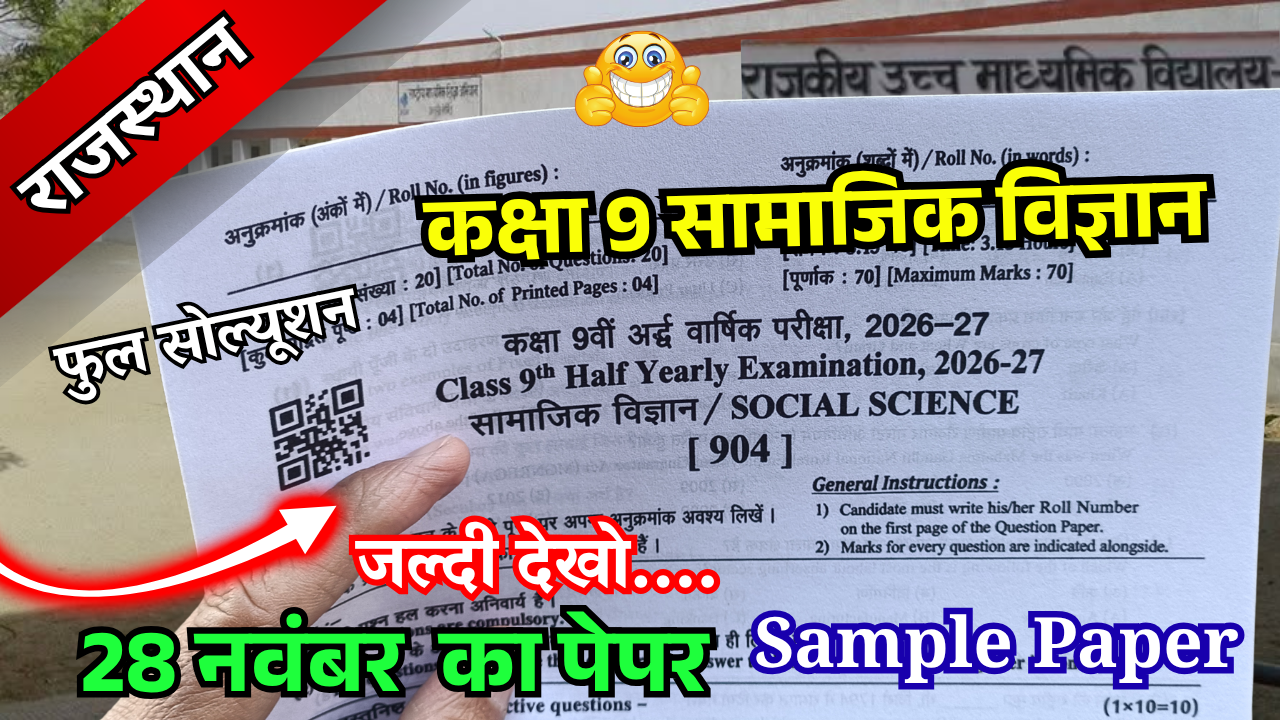
RBSE Class 9th Social Science Half Yearly Question Paper 2026-27 PDF | Complete Question Paper & Solution | कक्षा 9वीं सामाजिक विज्ञान अर्द्धवार्षिक पेपर हल
कक्षा 9वीं अर्द्धवार्षिक परीक्षा, 2026-27
SAMPLE QUESTION PAPER FOR PRACTICE ONLY
Class 9th Half Yearly Examination, 2026-27
सामाजिक विज्ञान / SOCIAL SCIENCE
प्रश्नपत्र कोड / Paper Code: 904
| विवरण | जानकारी |
|---|---|
| कुल प्रश्नों की संख्या / Total No. of Questions | 20 |
| कुल मुद्रित पृष्ठ / Total No. of Printed Pages | 04 |
| समय / Time | 3 घंटे 15 मिनट / 3.15 Hours |
| पूर्णांक / Maximum Marks | 70 |
सामान्य अनुदेश / General Instructions
- परीक्षार्थी प्रश्न-पत्र के पहले पृष्ठ पर अपना अनुक्रमांक अवश्य लिखें।
Candidate must write his/her Roll Number on the first page of the Question Paper. - प्रत्येक प्रश्न के सामने उसका अंक भार अंकित है।
Marks for every question are indicated alongside.
नोट / Note:
- सभी प्रश्न हल करने अनिवार्य हैं।
All questions are compulsory. - जिन प्रश्नों के आन्तरिक खण्ड हैं, उन सभी के उत्तर एक साथ ही लिखने हैं।
For questions having more than one part, the answers to these parts should be written together in continuity.
प्र.1 वस्तुनिष्ठ प्रश्न / Objective Questions (1×10=10)
(i) फ्रांस की क्रांति कब प्रारंभ हुई थी?
When did the French Revolution begin?
(अ) 1776 ई. / (A) 1776 AD
(ब) 1789 ई. / (B) 1789 AD
(स) 1791 ई. / (C) 1791 AD
(द) 1804 ई. / (D) 1804 AD
(ii) रूस में सामूहिकीकरण कार्यक्रम किसने प्रारंभ किया था?
Who started the collectivisation programme in Russia?
(अ) लेनिन / (A) Lenin
(ब) स्टालिन / (B) Stalin
(स) केरेन्स्की / (C) Kerensky
(द) जार निकोलस / (D) Tsar Nicholas
(iii) कर्क रेखा निम्न में से किस राज्य से होकर नहीं गुजरती है?
The Tropic of Cancer does not pass through which of the following states?
(अ) राजस्थान / (A) Rajasthan
(ब) ओडिशा / (B) Odisha
(स) छत्तीसगढ़ / (C) Chhattisgarh
(द) त्रिपुरा / (D) Tripura
(iv) एक स्थलीय भाग जो तीन ओर से समुद्र से घिरा हो, कहलाता है-
A landmass bounded by sea on three sides is referred to as –
(अ) तट / (A) Coast
(ब) प्रायद्वीप / (B) Peninsula
(स) द्वीप / (C) Island
(द) इनमें से कोई नहीं / (D) None of these
(v) दक्षिण अफ्रीका में रंगभेद के विरुद्ध संघर्ष करने वाले प्रमुख नेता थे-
The prominent leader who fought against apartheid in South Africa was –
(अ) अब्राहम लिंकन / (A) Abraham Lincoln
(ब) नेल्सन मंडेला / (B) Nelson Mandela
(स) मार्टिन लूथर / (C) Martin Luther
(द) जॉर्ज वाशिंगटन / (D) George Washington
(vi) भारत में लोकसभा चुनाव लड़ने के लिए न्यूनतम आयु कितनी निर्धारित है?
What is the minimum age prescribed to contest Lok Sabha elections in India?
(अ) 18 वर्ष / (A) 18 years
(ब) 21 वर्ष / (B) 21 years
(स) 25 वर्ष / (C) 25 years
(द) 30 वर्ष / (D) 30 years
(vii) वुलर झील निम्नलिखित में से किस राज्य में स्थित है?
In which of the following states is the Wular Lake located?
(अ) राजस्थान / (A) Rajasthan
(ब) पंजाब / (B) Punjab
(स) उत्तर प्रदेश / (C) Uttar Pradesh
(द) जम्मू-कश्मीर / (D) Jammu & Kashmir
(viii) गेहूँ और चना किस प्रकार की फसलें हैं?
What type of crops are Wheat and Gram?
(अ) खरीफ / (A) Kharif
(ब) रबी / (B) Rabi
(स) जायद / (C) Zaid
(द) उपर्युक्त सभी / (D) All of the above
(ix) महात्मा गांधी राष्ट्रीय ग्रामीण रोजगार गारंटी अधिनियम (मनरेगा) कब पारित हुआ?
When was the Mahatma Gandhi National Rural Employment Guarantee Act (MGNREGA) passed?
(अ) 2000 / (A) 2000
(ब) 2005 / (B) 2005
(स) 2009 / (C) 2009
(द) 2012 / (D) 2012
(x) निम्न में से कौनसा क्षेत्रक सबसे अधिक श्रम खपाने वाला क्षेत्रक है?
Which of the following is the most labour absorbing sector?
(अ) कृषि / (A) Agriculture
(ब) विनिर्माण / (B) Manufacturing
(स) बैंकिंग / (C) Banking
(द) परिवहन / (D) Transport
प्र.2 रिक्त स्थानों की पूर्ति कीजिए / Fill in the Blanks (1×8=8)
(i) फ्रांस की राष्ट्रीय मुद्रा ________ थी, जिसे 1794 में समाप्त कर दिया गया।
The national currency of France was ________, which was discontinued in 1794.
(ii) प्रथम विश्व युद्ध ________ से ________ ई. तक लड़ा गया।
The First World War was fought from ________ to ________ AD.
(iii) क्षेत्रफल की दृष्टि से भारत का विश्व में ________ स्थान है।
India holds the ________ rank in the world in terms of area.
(iv) भारत का संविधान ________ को लागू किया गया।
The Constitution of India came into effect on ________.
(v) चुनाव कराने के लिए देश को अनेक निर्वाचन क्षेत्रों में बाँटा जाता है, जिन्हें ________ कहते हैं।
For conducting elections, the country is divided into several areas called ________.
(vi) नर्मदा नदी का उद्गम मध्य प्रदेश में ________ की पहाड़ियों के निकट से होता है।
The Narmada River rises in the ________ hills in Madhya Pradesh.
(vii) जनसंख्या की गुणवत्ता मुख्यतः साक्षरता दर और ________ पर निर्भर करती है।
The quality of population mainly depends upon the literacy rate and ________.
(viii) उत्पादन के चार आवश्यक कारक भूमि, श्रम, भौतिक पूँजी और ________ हैं।
The four requirements for production are land, labour, physical capital and ________.
प्र.3 अति लघु उत्तरात्मक प्रश्न / Very Short Answer Type Questions (1×10=10)
(i) मित्र राष्ट्रों में कौन-कौन से प्रमुख देश शामिल थे?
Which major countries were included in the Allied Powers?
(ii) ‘आम्र वर्षा’ (मैंगो शावर) किसे कहते हैं?
What is meant by ‘Mango Shower’?
(iii) ‘टाइले’ (Taille) क्या था?
What was ‘Taille’?
(iv) निर्धनता रेखा से क्या अभिप्राय है?
What is meant by Poverty Line?
(v) तृतीयक क्षेत्रक की कोई दो गतिविधियाँ लिखिए।
Write any two activities of the Tertiary Sector.
(vi) लोकतंत्र की एक सर्वमान्य परिभाषा लिखिए।
Write one widely accepted definition of Democracy.
(vii) स्थायी पूँजी के दो उदाहरण दीजिए।
Give two examples of Fixed Capital.
(viii) भारतीय संविधान सभा के स्थायी अध्यक्ष कौन थे?
Who was the permanent President of the Indian Constituent Assembly?
(ix) भारत की स्थलीय सीमा की कुल लम्बाई कितनी है?
What is the total length of the land boundary of India?
(x) ‘पंथनिरपेक्ष’ (Secular) शब्द का क्या अर्थ है?
What is the meaning of the word ‘Secular’?
लघु उत्तरात्मक प्रश्न-I / Short Answer Type Questions-I (1.5×6=9)
प्र.4 बांगर और खादर में कोई दो अन्तर लिखिए।
Write any two differences between Bhangar and Khadar.
प्र.5 ‘खूनी रविवार’ की घटना का संक्षिप्त वर्णन कीजिए।
Briefly describe the incident of ‘Bloody Sunday’.
प्र.6 हमें संविधान की आवश्यकता क्यों होती है? कोई तीन कारण लिखिए।
Why do we need a Constitution? Write any three reasons.
प्र.7 हिमालय से निकलने वाली नदियों की कोई तीन विशेषताएँ लिखिए।
Write any three characteristics of the rivers originating from the Himalayas.
प्र.8 भारत के प्रमुख भौतिक विभागों के नाम लिखिए।
Write the names of the major physiographic divisions of India.
प्र.9 लोकतंत्र के खिलाफ दिए जाने वाले कोई तीन तर्क लिखिए।
Write any three arguments given against democracy.
लघु उत्तरात्मक प्रश्न-II / Short Answer Type Questions-II (2×6=12)
प्र.10 1917 की अक्टूबर क्रांति के बाद बोल्शेविकों द्वारा किए गए कोई दो प्रमुख परिवर्तन लिखिए।
Write any two major changes brought about by the Bolsheviks after the October Revolution of 1917.
प्र.11 भारत में निर्धनता उन्मूलन के लिए सरकार द्वारा चलाए गए किन्हीं दो कार्यक्रमों का वर्णन कीजिए।
Describe any two programmes launched by the government for poverty alleviation in India.
प्र.12 पूर्वी तटीय मैदान तथा पश्चिमी तटीय मैदान में कोई दो अन्तर स्पष्ट कीजिए।
Clarify any two differences between the Eastern Coastal Plain and the Western Coastal Plain.
प्र.13 ‘आदर्श चुनाव आचार संहिता’ क्या है? इसके दो प्रमुख प्रावधान लिखिए।
What is ‘Model Code of Conduct’? Write its two main provisions.
प्र.14 सर्वोच्च न्यायालय के कोई दो प्रमुख अधिकार एवं कार्य बताइए।
State any two major powers and functions of the Supreme Court.
प्र.15 मौसमी बेरोजगारी और प्रच्छन्न बेरोजगारी में क्या अन्तर है?
What is the difference between Seasonal Unemployment and Disguised Unemployment?
दीर्घ उत्तरात्मक प्रश्न / Long Answer Type Questions (3×3=9)
प्र.16 भारत की जलवायु को प्रभावित करने वाले प्रमुख कारकों का वर्णन कीजिए।
Describe the major factors affecting the climate of India.
प्र.17 उत्तरी भारत के विशाल मैदान का निर्माण किस प्रकार हुआ है? इसकी प्रमुख विशेषताएँ लिखिए।
How was the Great Northern Plain of India formed? Write its main characteristics.
प्र.18 मानव पूँजी निर्माण में स्वास्थ्य सेवाओं की क्या भूमिका है? स्पष्ट कीजिए।
What is the role of health services in human capital formation? Clarify.
निबन्धात्मक प्रश्न / Essay Type Questions (6×2=12)
प्र.19 1789 की फ्रांसीसी क्रांति के प्रमुख कारणों की विवेचना कीजिए।
Discuss the main causes of the French Revolution of 1789.
अथवा / OR
नात्सी सोच के प्रमुख पहलू क्या थे? स्पष्ट कीजिए।
What were the key aspects of Nazi thinking? Clarify.
प्र.20 भारत के मानचित्र में निम्नलिखित स्थानों को दर्शाइए।
Show the following places on the map of India.
(अ) कोलकाता / (A) Kolkata
(ब) गुजरात / (B) Gujarat
(स) गोवा / (C) Goa
(द) तमिलनाडु / (D) Tamil Nadu
(य) चिल्का झील / (E) Chilika Lake
(र) अंडमान व निकोबार / (F) Andaman & Nicobar
अथवा / OR
भारत के मानचित्र में निम्नलिखित स्थानों को दर्शाइए।
Show the following places on the map of India.
(अ) पंजाब / (A) Punjab
(ब) मेघालय / (B) Meghalaya
(स) जयपुर / (C) Jaipur
(द) चेन्नई / (D) Chennai
(य) नर्मदा नदी / (E) Narmada River
(र) छोटा नागपुर पठार / (F) Chota Nagpur Plateau
संपूर्ण प्रश्नपत्र का हल (Complete Solution)
प्रश्न 1. वस्तुनिष्ठ प्रश्नों के सही विकल्प लिखिए। (1×10=10)
(i) फ्रांस की क्रांति कब प्रारंभ हुई थी?
उत्तर – (ब) 1789 ई. / (B) 1789 AD
(ii) रूस में सामूहिकीकरण कार्यक्रम किसने प्रारंभ किया था?
उत्तर – (ब) स्टालिन / (B) Stalin
(iii) कर्क रेखा किस राज्य से होकर नहीं गुजरती है?
उत्तर – (ब) ओडिशा / (B) Odisha
(iv) तीन ओर से समुद्र से घिरा स्थलीय भाग कहलाता है-
उत्तर – (ब) प्रायद्वीप / (B) Peninsula
(v) दक्षिण अफ्रीका में रंगभेद के विरुद्ध संघर्ष करने वाले प्रमुख नेता थे-
उत्तर – (ब) नेल्सन मंडेला / (B) Nelson Mandela
(vi) लोकसभा चुनाव लड़ने की न्यूनतम आयु है-
उत्तर – (स) 25 वर्ष / (C) 25 years
(vii) वुलर झील स्थित है-
उत्तर – (द) जम्मू-कश्मीर / (D) Jammu & Kashmir
(viii) गेहूँ और चना किस प्रकार की फसलें हैं?
उत्तर – (ब) रबी / (B) Rabi
(ix) मनरेगा अधिनियम कब पारित हुआ?
उत्तर – (ब) 2005 / (B) 2005
(x) सबसे अधिक श्रम खपाने वाला क्षेत्रक है-
उत्तर – (अ) कृषि / (A) Agriculture
प्रश्न 2. रिक्त स्थानों की पूर्ति कीजिए। (1×8=8)
(i) फ्रांस की राष्ट्रीय मुद्रा लिव्रे (Livre) थी।
The national currency of France was Livre.
(ii) प्रथम विश्व युद्ध 1914 से 1918 ई. तक लड़ा गया।
The First World War was fought from 1914 to 1918 AD.
(iii) क्षेत्रफल की दृष्टि से भारत का विश्व में सातवाँ स्थान है।
India holds the seventh rank in the world in terms of area.
(iv) भारत का संविधान 26 जनवरी 1950 को लागू किया गया।
The Constitution of India came into effect on 26 January 1950.
(v) निर्वाचन क्षेत्रों को निर्वाचन क्षेत्र / निर्वाचन क्षेत्र (Constituencies) कहते हैं।
These areas are called Constituencies.
(vi) नर्मदा नदी का उद्गम मध्य प्रदेश में अमरकंटक की पहाड़ियों के निकट से होता है।
The Narmada River rises near the Amarkantak hills.
(vii) जनसंख्या की गुणवत्ता मुख्यतः साक्षरता दर और स्वास्थ्य पर निर्भर करती है।
The quality of population mainly depends upon the literacy rate and health.
(viii) उत्पादन के चार आवश्यक कारक भूमि, श्रम, भौतिक पूँजी और मानव पूँजी हैं।
The four requirements for production are land, labour, physical capital and human capital.
प्रश्न 3. अति लघु उत्तरीय प्रश्नों के उत्तर दीजिए। (1×10=10)
(i) मित्र राष्ट्रों में कौन-कौन से प्रमुख देश शामिल थे?
उत्तर – प्रथम विश्व युद्ध में मित्र राष्ट्रों के प्रमुख देशों में ब्रिटेन, फ्रांस और रूस शामिल थे। बाद में अमेरिका भी इसमें शामिल हुआ।
Which major countries were included in the Allied Powers?
Answer – The major Allied Powers included Britain, France and Russia. Later, the United States also joined them.
(ii) ‘आम्र वर्षा’ (मैंगो शावर) किसे कहते हैं?
उत्तर – भारत के दक्षिणी भागों, विशेषकर केरल और कर्नाटक में मानसून से पहले होने वाली वर्षा को आम्र वर्षा कहते हैं। यह आमों को पकने में सहायता करती है।
What is meant by Mango Shower?
Answer – Mango showers are pre-monsoon showers occurring mainly in Kerala and Karnataka. They help in the ripening of mangoes.
(iii) ‘टाइले’ (Taille) क्या था?
उत्तर – टाइले फ्रांस में लगाया जाने वाला प्रत्यक्ष भूमि कर था, जिसे मुख्यतः सामान्य जनता और किसानों को देना पड़ता था।
What was Taille?
Answer – Taille was a direct land tax imposed in France, mainly on the common people and peasants.
(iv) निर्धनता रेखा से क्या अभिप्राय है?
उत्तर – निर्धनता रेखा वह न्यूनतम आय या उपभोग स्तर है, जिसके आधार पर यह निर्धारित किया जाता है कि व्यक्ति अपनी मूलभूत आवश्यकताएँ पूरी कर सकता है या नहीं।
What is meant by Poverty Line?
Answer – The poverty line is the minimum income or consumption level used to determine whether a person can meet basic needs.
(v) तृतीयक क्षेत्रक की कोई दो गतिविधियाँ लिखिए।
उत्तर – बैंकिंग और परिवहन तृतीयक क्षेत्रक की दो प्रमुख गतिविधियाँ हैं।
Write any two activities of the Tertiary Sector.
Answer – Banking and transport are two major activities of the tertiary sector.
(vi) लोकतंत्र की एक सर्वमान्य परिभाषा लिखिए।
उत्तर – लोकतंत्र शासन की वह व्यवस्था है जिसमें शासकों का चुनाव जनता द्वारा किया जाता है।
Write one widely accepted definition of Democracy.
Answer – Democracy is a form of government in which the rulers are elected by the people.
(vii) स्थायी पूँजी के दो उदाहरण दीजिए।
उत्तर – मशीनें और भवन स्थायी पूँजी के दो उदाहरण हैं।
Give two examples of Fixed Capital.
Answer – Machines and buildings are two examples of fixed capital.
(viii) भारतीय संविधान सभा के स्थायी अध्यक्ष कौन थे?
उत्तर – डॉ. राजेंद्र प्रसाद भारतीय संविधान सभा के स्थायी अध्यक्ष थे।
Who was the permanent President of the Indian Constituent Assembly?
Answer – Dr. Rajendra Prasad was the permanent President of the Indian Constituent Assembly.
(ix) भारत की स्थलीय सीमा की कुल लम्बाई कितनी है?
उत्तर – भारत की स्थलीय सीमा की कुल लंबाई लगभग 15,200 किलोमीटर है।
What is the total length of the land boundary of India?
Answer – The total length of India’s land boundary is approximately 15,200 kilometres.
(x) ‘पंथनिरपेक्ष’ (Secular) शब्द का क्या अर्थ है?
उत्तर – पंथनिरपेक्ष का अर्थ है कि राज्य का कोई अपना आधिकारिक धर्म नहीं होता और सभी धर्मों को समान सम्मान एवं स्वतंत्रता प्राप्त होती है।
What is the meaning of the word Secular?
Answer – Secular means that the state has no official religion and treats all religions equally.
प्रश्न 4. बांगर और खादर में कोई दो अन्तर लिखिए। (1.5)
उत्तर –
| बांगर | खादर |
|---|---|
| बांगर पुरानी जलोढ़ मिट्टी है। | खादर नई जलोढ़ मिट्टी है। |
| यह बाढ़ के मैदान से ऊँचे भागों में मिलती है तथा इसमें कंकड़ पाए जाते हैं। | यह नदियों के बाढ़ वाले मैदानों में मिलती है और सामान्यतः अधिक उपजाऊ होती है। |
Write any two differences between Bhangar and Khadar.
Answer –
| Bhangar | Khadar |
|---|---|
| Bhangar is old alluvial soil. | Khadar is new alluvial soil. |
| It is found in higher areas and often contains calcareous deposits. | It is found in floodplains and is generally more fertile. |
प्रश्न 5. ‘खूनी रविवार’ की घटना का संक्षिप्त वर्णन कीजिए। (1.5)
उत्तर – 22 जनवरी 1905 को रूस के सेंट पीटर्सबर्ग में फादर गैपॉन के नेतृत्व में मजदूरों का एक शांतिपूर्ण जुलूस जार के महल की ओर जा रहा था। मजदूर अपनी माँगें जार तक पहुँचाना चाहते थे। सैनिकों ने निहत्थे प्रदर्शनकारियों पर गोली चला दी, जिसमें अनेक लोग मारे गए और घायल हुए। इस घटना को खूनी रविवार कहा जाता है।
Briefly describe the incident of Bloody Sunday.
Answer – On 22 January 1905, workers led by Father Gapon marched peacefully towards the Tsar’s palace in St. Petersburg, Russia. They wanted to present their demands to the Tsar. The soldiers fired on the unarmed crowd, killing and injuring many people. This incident came to be known as Bloody Sunday.
प्रश्न 6. हमें संविधान की आवश्यकता क्यों होती है? कोई तीन कारण लिखिए। (1.5)
उत्तर –
- संविधान देश के शासन को चलाने के लिए नियम और सिद्धांत निर्धारित करता है।
- यह सरकार की शक्तियों को सीमित करता है और नागरिकों के अधिकारों की रक्षा करता है।
- यह विभिन्न समुदायों के बीच विश्वास और सहयोग बनाए रखने में सहायता करता है।
Why do we need a Constitution? Write any three reasons.
Answer –
- A Constitution lays down the rules and principles for governing a country.
- It limits the powers of the government and protects the rights of citizens.
- It helps maintain trust and cooperation among different communities.
प्रश्न 7. हिमालय से निकलने वाली नदियों की कोई तीन विशेषताएँ लिखिए। (1.5)
उत्तर –
- हिमालय से निकलने वाली नदियाँ सामान्यतः बारहमासी होती हैं, क्योंकि इन्हें हिमनदों के पिघलने और वर्षा से जल मिलता है।
- ये नदियाँ लंबा मार्ग तय करती हैं और अपने साथ उपजाऊ जलोढ़ मिट्टी लाती हैं।
- मैदानी क्षेत्रों में ये नदियाँ मोड़ बनाती हैं और बड़े-बड़े मैदानों का निर्माण करती हैं।
Write any three characteristics of the rivers originating from the Himalayas.
Answer –
- Himalayan rivers are generally perennial because they receive water from melting glaciers and rainfall.
- They travel long distances and carry fertile alluvial soil.
- In the plains, they form meanders and help create extensive fertile plains.
प्रश्न 8. भारत के प्रमुख भौतिक विभागों के नाम लिखिए। (1.5)
उत्तर – भारत के प्रमुख भौतिक विभाग निम्नलिखित हैं:
- हिमालय पर्वतीय क्षेत्र
- उत्तरी विशाल मैदान
- प्रायद्वीपीय पठार
- भारतीय मरुस्थल
- तटीय मैदान
- द्वीप समूह
Write the names of the major physiographic divisions of India.
Answer – The major physiographic divisions of India are:
- The Himalayan Mountains
- The Northern Plains
- The Peninsular Plateau
- The Indian Desert
- The Coastal Plains
- The Islands
प्रश्न 9. लोकतंत्र के खिलाफ दिए जाने वाले कोई तीन तर्क लिखिए। (1.5)
उत्तर –
- लोकतंत्र में निर्णय लेने की प्रक्रिया कभी-कभी धीमी होती है।
- चुनावों में राजनीतिक प्रतिस्पर्धा के कारण धन और शक्ति का दुरुपयोग हो सकता है।
- राजनीतिक दलों में सत्ता प्राप्त करने की होड़ के कारण भ्रष्टाचार और अस्थिरता की समस्या उत्पन्न हो सकती है।
Write any three arguments given against democracy.
Answer –
- Decision-making in a democracy can sometimes be slow.
- Money and power may be misused during elections due to political competition.
- Competition for power among political parties may lead to corruption and instability.
प्रश्न 10. 1917 की अक्टूबर क्रांति के बाद बोल्शेविकों द्वारा किए गए कोई दो प्रमुख परिवर्तन लिखिए। (2)
उत्तर –
- बोल्शेविक सरकार ने बड़े उद्योगों और बैंकों का राष्ट्रीयकरण कर दिया तथा उन पर सरकारी नियंत्रण स्थापित किया।
- किसानों से संबंधित भूमि को सामाजिक संपत्ति घोषित किया गया और जमींदारों की भूमि पर उनका अधिकार समाप्त किया गया।
Write any two major changes brought about by the Bolsheviks after the October Revolution of 1917.
Answer –
- The Bolshevik government nationalised major industries and banks and brought them under government control.
- Land was declared social property and the rights of landlords over land were abolished.
प्रश्न 11. भारत में निर्धनता उन्मूलन के लिए सरकार द्वारा चलाए गए किन्हीं दो कार्यक्रमों का वर्णन कीजिए। (2)
उत्तर –
- महात्मा गांधी राष्ट्रीय ग्रामीण रोजगार गारंटी अधिनियम (मनरेगा): इस योजना के अंतर्गत ग्रामीण परिवारों को एक वित्तीय वर्ष में 100 दिनों के मजदूरी रोजगार की गारंटी दी जाती है।
- प्रधानमंत्री रोजगार योजना (PMRY): इस योजना का उद्देश्य शिक्षित बेरोजगार युवाओं को स्वरोजगार के अवसर उपलब्ध कराना और छोटे व्यवसाय शुरू करने में सहायता देना था।
Describe any two programmes launched by the government for poverty alleviation in India.
Answer –
- Mahatma Gandhi National Rural Employment Guarantee Act (MGNREGA): It provides a guarantee of 100 days of wage employment to rural households in a financial year.
- Prime Minister Rozgar Yojana (PMRY): It aimed to provide self-employment opportunities and assistance to educated unemployed youth for starting small businesses.
प्रश्न 12. पूर्वी तटीय मैदान तथा पश्चिमी तटीय मैदान में कोई दो अन्तर स्पष्ट कीजिए। (2)
उत्तर –
| पूर्वी तटीय मैदान | पश्चिमी तटीय मैदान |
|---|---|
| यह बंगाल की खाड़ी के किनारे स्थित है। | यह अरब सागर के किनारे स्थित है। |
| यह अपेक्षाकृत चौड़ा है तथा यहाँ महानदी, गोदावरी, कृष्णा और कावेरी नदियों के डेल्टा पाए जाते हैं। | यह अपेक्षाकृत संकरा है तथा यहाँ अनेक नदियों के मुहानों पर ज्वारनदमुख पाए जाते हैं। |
Clarify any two differences between the Eastern Coastal Plain and the Western Coastal Plain.
Answer –
| Eastern Coastal Plain | Western Coastal Plain |
|---|---|
| It lies along the Bay of Bengal. | It lies along the Arabian Sea. |
| It is relatively wider and has large river deltas. | It is relatively narrower and has many estuaries. |
प्रश्न 13. ‘आदर्श चुनाव आचार संहिता’ क्या है? इसके दो प्रमुख प्रावधान लिखिए। (2)
उत्तर – चुनाव के समय राजनीतिक दलों और उम्मीदवारों के व्यवहार को नियंत्रित करने के लिए निर्वाचन आयोग द्वारा निर्धारित नियमों को आदर्श चुनाव आचार संहिता कहते हैं।
इसके दो प्रमुख प्रावधान:
- राजनीतिक दल धर्म, जाति या भाषा के आधार पर मतदाताओं से वोट नहीं माँग सकते।
- सत्ताधारी दल सरकारी संसाधनों और सरकारी पदों का चुनावी लाभ के लिए दुरुपयोग नहीं कर सकता।
What is Model Code of Conduct? Write its two main provisions.
Answer – The Model Code of Conduct is a set of guidelines issued by the Election Commission to regulate the conduct of political parties and candidates during elections.
Two main provisions:
- Political parties cannot seek votes on the basis of religion, caste or language.
- The ruling party cannot misuse government resources or official position for electoral benefits.
प्रश्न 14. सर्वोच्च न्यायालय के कोई दो प्रमुख अधिकार एवं कार्य बताइए। (2)
उत्तर –
- सर्वोच्च न्यायालय संविधान का संरक्षक है। यह संविधान के विरुद्ध बनाए गए कानूनों को असंवैधानिक घोषित कर सकता है।
- यह केंद्र और राज्यों के बीच तथा विभिन्न राज्यों के बीच उत्पन्न विवादों का निपटारा करता है।
State any two major powers and functions of the Supreme Court.
Answer –
- The Supreme Court is the guardian of the Constitution. It can declare laws unconstitutional if they violate the Constitution.
- It settles disputes between the Union and the States and among different States.
प्रश्न 15. मौसमी बेरोजगारी और प्रच्छन्न बेरोजगारी में क्या अन्तर है? (2)
उत्तर –
| मौसमी बेरोजगारी | प्रच्छन्न बेरोजगारी |
|---|---|
| जब लोगों को वर्ष के कुछ विशेष महीनों में ही काम मिलता है, तो इसे मौसमी बेरोजगारी कहते हैं। | जब किसी काम में आवश्यकता से अधिक लोग लगे होते हैं और कुछ लोगों को हटाने पर भी उत्पादन कम नहीं होता, तो इसे प्रच्छन्न बेरोजगारी कहते हैं। |
| यह कृषि जैसे मौसमी कार्यों में अधिक दिखाई देती है। | यह कृषि और असंगठित कार्यों में अधिक दिखाई देती है। |
What is the difference between Seasonal Unemployment and Disguised Unemployment?
Answer –
| Seasonal Unemployment | Disguised Unemployment |
|---|---|
| It occurs when people get work only during certain months of the year. | It occurs when more people are engaged in a job than actually required, and removing some workers does not reduce output. |
| It is common in seasonal activities such as agriculture. | It is common in agriculture and other informal activities. |
प्रश्न 16. भारत की जलवायु को प्रभावित करने वाले प्रमुख कारकों का वर्णन कीजिए। (3)
उत्तर – भारत की जलवायु को प्रभावित करने वाले प्रमुख कारक निम्नलिखित हैं:
- अक्षांशीय स्थिति: भारत का बड़ा भाग उष्णकटिबंधीय क्षेत्र में स्थित है। कर्क रेखा भारत के मध्य से गुजरती है, इसलिए देश के विभिन्न भागों में तापमान में अंतर पाया जाता है।
- ऊँचाई: ऊँचाई बढ़ने के साथ तापमान कम होता जाता है। इसी कारण हिमालय के ऊँचे भागों में अधिक ठंड रहती है।
- समुद्र से दूरी: समुद्र के निकट स्थित क्षेत्रों की जलवायु सम रहती है, जबकि समुद्र से दूर स्थित क्षेत्रों में तापमान का अंतर अधिक होता है।
- वायुदाब और पवनें: मानसूनी पवनें भारत में वर्षा का प्रमुख कारण हैं।
- पर्वतीय अवरोध: हिमालय पर्वत ठंडी मध्य एशियाई हवाओं को रोकता है और मानसूनी पवनों को वर्षा करने में सहायता करता है।
Describe the major factors affecting the climate of India.
Answer – The major factors affecting the climate of India are:
- Latitude: A large part of India lies in the tropical region. The Tropic of Cancer passes through the middle of the country, affecting its temperature.
- Altitude: Temperature decreases with an increase in altitude. Therefore, the higher Himalayan regions remain colder.
- Distance from the Sea: Coastal areas have a moderate climate, while areas far from the sea experience greater temperature variations.
- Pressure and Winds: Monsoon winds are the main source of rainfall in India.
- Relief Features: The Himalayas block cold winds from Central Asia and help the monsoon winds cause rainfall.
प्रश्न 17. उत्तरी भारत के विशाल मैदान का निर्माण किस प्रकार हुआ है? इसकी प्रमुख विशेषताएँ लिखिए। (3)
उत्तर – उत्तरी भारत के विशाल मैदान का निर्माण सिंधु, गंगा और ब्रह्मपुत्र नदी तंत्र तथा उनकी सहायक नदियों द्वारा लाए गए जलोढ़ निक्षेपों से हुआ है। लाखों वर्षों तक इन नदियों ने अपने साथ लाई गई मिट्टी, बालू और गाद को जमा किया, जिससे विशाल मैदान का निर्माण हुआ।
प्रमुख विशेषताएँ:
- यह मैदान बहुत समतल और उपजाऊ है।
- यहाँ जल की पर्याप्त उपलब्धता और उपजाऊ मिट्टी के कारण कृषि का विकास हुआ है।
- यहाँ जनसंख्या का घनत्व अधिक है तथा परिवहन और संचार के साधनों का अच्छा विकास हुआ है।
How was the Great Northern Plain of India formed? Write its main characteristics.
Answer – The Great Northern Plain of India was formed by the alluvial deposits brought by the Indus, Ganga and Brahmaputra river systems and their tributaries. Over millions of years, these rivers deposited silt, sand and other sediments, creating the vast plain.
Main Characteristics:
- It is very flat and fertile.
- It has sufficient water and fertile soil, which support agriculture.
- It is densely populated and has well-developed transport and communication facilities.
प्रश्न 18. मानव पूँजी निर्माण में स्वास्थ्य सेवाओं की क्या भूमिका है? स्पष्ट कीजिए। (3)
उत्तर – मानव पूँजी निर्माण में स्वास्थ्य सेवाओं की महत्वपूर्ण भूमिका होती है।
- स्वस्थ व्यक्ति अधिक कार्यक्षमता और ऊर्जा के साथ काम कर सकता है।
- स्वास्थ्य सेवाएँ बीमारियों को रोकती हैं और श्रमिकों की कार्यक्षमता बढ़ाती हैं।
- स्वस्थ जनसंख्या शिक्षा और प्रशिक्षण का बेहतर लाभ उठा सकती है, जिससे उत्पादन और आय में वृद्धि होती है।
इस प्रकार स्वास्थ्य सेवाएँ मानव पूँजी की गुणवत्ता बढ़ाने में सहायता करती हैं।
What is the role of health services in human capital formation? Clarify.
Answer – Health services play an important role in human capital formation.
- A healthy person can work with greater efficiency and energy.
- Health services prevent diseases and improve the working capacity of people.
- A healthy population can benefit more from education and training, increasing productivity and income.
Thus, health services improve the quality of human capital.
प्रश्न 19. 1789 की फ्रांसीसी क्रांति के प्रमुख कारणों की विवेचना कीजिए। (6)
उत्तर – फ्रांसीसी क्रांति के प्रमुख कारण
1789 की फ्रांसीसी क्रांति के प्रमुख कारण निम्नलिखित थे:
- सामाजिक असमानता: फ्रांस का समाज तीन वर्गों में बँटा हुआ था। प्रथम वर्ग में पादरी, द्वितीय वर्ग में कुलीन और तृतीय वर्ग में सामान्य जनता आती थी। पहले दो वर्गों को विशेष अधिकार प्राप्त थे, जबकि करों का अधिक बोझ तीसरे वर्ग पर था।
- आर्थिक संकट: फ्रांस की सरकार पर बहुत अधिक कर्ज था। राजदरबार के खर्च और युद्धों के कारण आर्थिक स्थिति खराब हो गई थी।
- करों का असमान बोझ: सामान्य जनता को अनेक प्रकार के कर देने पड़ते थे, जबकि विशेषाधिकार प्राप्त वर्गों को कई करों से छूट थी।
- महँगाई और खाद्यान्न संकट: जनसंख्या बढ़ने और फसल खराब होने के कारण रोटी की कीमतें बढ़ गई थीं। गरीब जनता को भोजन प्राप्त करना कठिन हो गया था।
- निरंकुश राजतंत्र: राजा लुई सोलहवाँ निरंकुश शासन करता था। जनता को शासन में पर्याप्त भागीदारी नहीं मिलती थी।
- दार्शनिकों के विचार: रूसो, लॉक और मोंटेस्क्यू जैसे विचारकों ने स्वतंत्रता, समानता और जनता के अधिकारों के विचारों का प्रचार किया। इन विचारों ने जनता को क्रांति के लिए प्रेरित किया।
इन सभी कारणों से 1789 में फ्रांस में क्रांति प्रारंभ हुई और निरंकुश राजतंत्र को चुनौती मिली।
Discuss the main causes of the French Revolution of 1789.
Answer – Main Causes of the French Revolution
The major causes of the French Revolution of 1789 were:
- Social Inequality: French society was divided into three estates. The clergy and nobility enjoyed special privileges, while the Third Estate carried most of the tax burden.
- Economic Crisis: France had a huge national debt due to wars and the luxurious expenses of the royal court.
- Unequal Tax Burden: Common people had to pay many taxes, whereas privileged classes enjoyed several exemptions.
- Inflation and Food Shortage: Population growth and poor harvests increased the price of bread and created hardship for ordinary people.
- Absolute Monarchy: King Louis XVI followed an absolute system of rule, and people had little participation in government.
- Ideas of Philosophers: Thinkers such as Rousseau, Locke and Montesquieu spread ideas of liberty, equality and people’s rights.
These conditions led to the French Revolution in 1789 and challenged the absolute monarchy.
अथवा / OR
नात्सी सोच के प्रमुख पहलू क्या थे? स्पष्ट कीजिए।
उत्तर – नात्सी सोच के प्रमुख पहलू
नात्सी विचारधारा के प्रमुख पहलू निम्नलिखित थे:
- आर्य नस्ल की श्रेष्ठता: नात्सियों का मानना था कि जर्मन आर्य नस्ल सबसे श्रेष्ठ है और अन्य नस्लें उससे निम्न हैं।
- यहूदी विरोध: नात्सी विचारधारा में यहूदियों के प्रति घृणा और भेदभाव को बढ़ावा दिया गया।
- तानाशाही शासन: हिटलर एक शक्तिशाली नेता के रूप में संपूर्ण सत्ता अपने हाथ में रखना चाहता था। वह लोकतंत्र और राजनीतिक विरोध का विरोधी था।
- जीवन-क्षेत्र का विस्तार: नात्सियों का उद्देश्य जर्मनी के लिए अधिक भू-भाग प्राप्त करना था, जिसे उन्होंने लेबेन्सराउम कहा।
- सैन्यवाद और राष्ट्रवाद: नात्सी युद्ध, सैन्य शक्ति और आक्रामक राष्ट्रवाद में विश्वास करते थे।
- प्रचार और नियंत्रण: नात्सी सरकार ने शिक्षा, मीडिया और प्रचार के माध्यम से अपने विचारों को जनता पर थोपने का प्रयास किया।
What were the key aspects of Nazi thinking? Clarify.
Answer – Key Aspects of Nazi Thinking
The major aspects of Nazi ideology were:
- Superiority of the Aryan Race: Nazis believed that the German Aryan race was superior to all other races.
- Anti-Semitism: Nazi ideology promoted hatred and discrimination against Jewish people.
- Dictatorship: Hitler wanted to hold absolute power and opposed democracy and political opposition.
- Expansion of Living Space: Nazis wanted to acquire more territory for Germany. This idea was called Lebensraum.
- Militarism and Nationalism: Nazis believed in military strength, war and aggressive nationalism.
- Propaganda and Control: The Nazi government tried to spread its ideology through education, media and propaganda.
प्रश्न 20. भारत के मानचित्र में निम्नलिखित स्थानों को दर्शाइए। (6)
विकल्प 1
उत्तर – मानचित्र में निम्न स्थानों को अंकित करें:
- कोलकाता: पश्चिम बंगाल के पूर्वी भाग में।
- गुजरात: भारत के पश्चिमी भाग में।
- गोवा: महाराष्ट्र और कर्नाटक के बीच पश्चिमी तट पर।
- तमिलनाडु: भारत के दक्षिण-पूर्वी भाग में।
- चिल्का झील: ओडिशा के तटीय क्षेत्र में, बंगाल की खाड़ी के निकट।
- अंडमान व निकोबार: बंगाल की खाड़ी में स्थित द्वीप समूह।
Show the following places on the map of India.
Answer – Mark the following places on the map:
- Kolkata: In the eastern part of West Bengal.
- Gujarat: In the western part of India.
- Goa: On the western coast, between Maharashtra and Karnataka.
- Tamil Nadu: In the south-eastern part of India.
- Chilika Lake: In the coastal region of Odisha, near the Bay of Bengal.
- Andaman & Nicobar: Island groups located in the Bay of Bengal.
अथवा / OR
भारत के मानचित्र में निम्नलिखित स्थानों को दर्शाइए।
उत्तर – मानचित्र में निम्न स्थानों को अंकित करें:
- पंजाब: भारत के उत्तर-पश्चिमी भाग में।
- मेघालय: उत्तर-पूर्वी भारत में, असम के दक्षिण में।
- जयपुर: राजस्थान के पूर्वी भाग में।
- चेन्नई: तमिलनाडु के उत्तर-पूर्वी तट पर।
- नर्मदा नदी: मध्य प्रदेश से पश्चिम की ओर बहते हुए गुजरात में अरब सागर तक।
- छोटा नागपुर पठार: मुख्यतः झारखंड में तथा आसपास के क्षेत्रों में फैला हुआ।
Show the following places on the map of India.
Answer – Mark the following places on the map:
- Punjab: In the north-western part of India.
- Meghalaya: In north-eastern India, south of Assam.
- Jaipur: In the eastern part of Rajasthan.
- Chennai: On the north-eastern coast of Tamil Nadu.
- Narmada River: Flowing westwards from Madhya Pradesh through Gujarat towards the Arabian Sea.
- Chota Nagpur Plateau: Mainly located in Jharkhand and adjoining regions.
विद्यार्थियों के लिए महत्वपूर्ण सूचना
प्रश्न 20 मानचित्र आधारित प्रश्न है। विद्यार्थियों को केवल स्थानों के नाम याद करने के बजाय भारत के राजनीतिक एवं भौतिक मानचित्र पर उनका सही स्थान अंकित करने का अभ्यास करना चाहिए।
नोट: यह अध्ययन और अभ्यास के लिए तैयार किया गया समाधान है। विद्यालय द्वारा दिए गए निर्देशों और निर्धारित पाठ्यक्रम को प्राथमिकता दें।
Rajesh Sir Official
Website: https://rajeshsir.co.in/
RBSE Class 9th Social Science Half Yearly Question Paper 2026-27 PDF