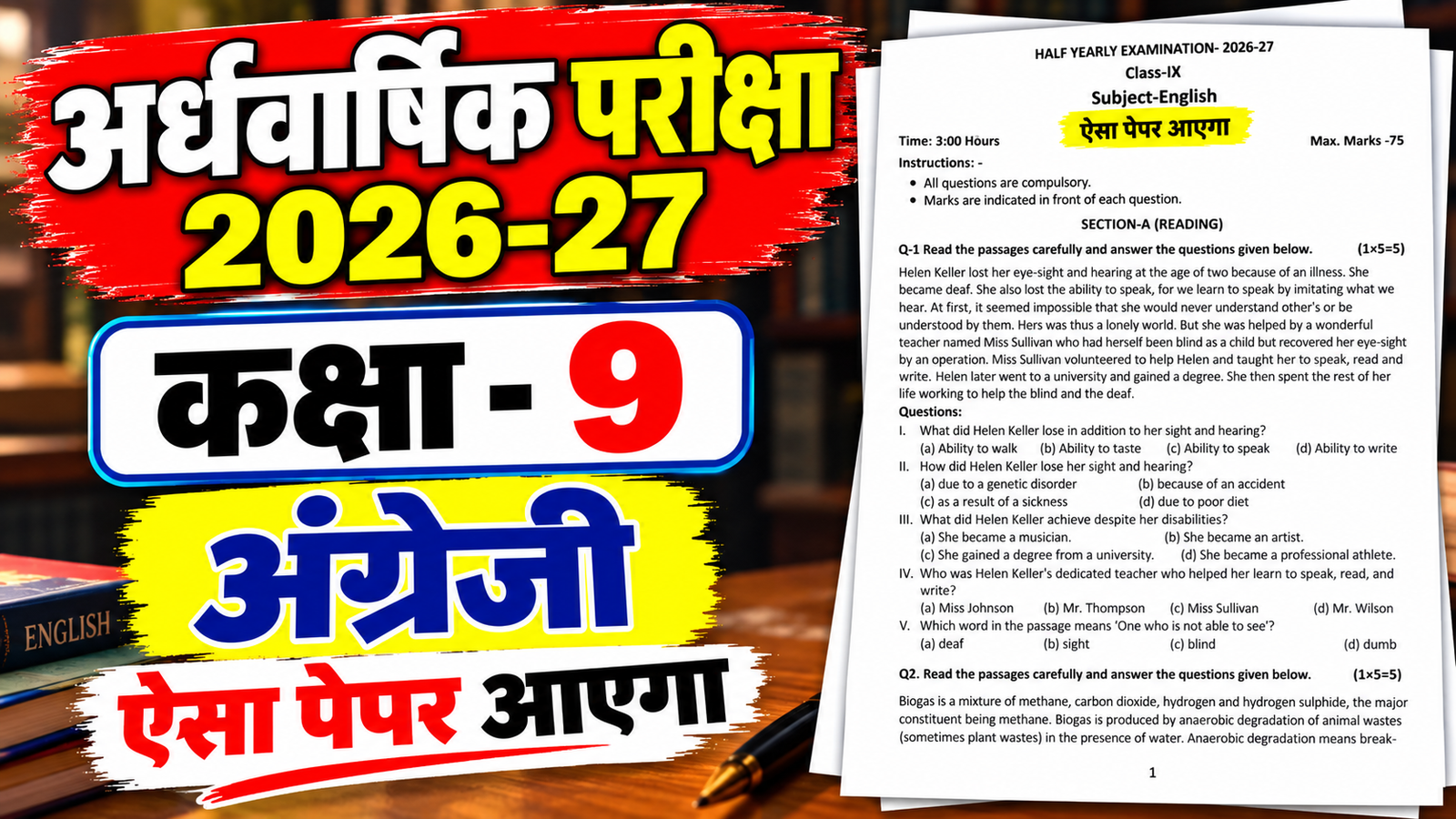
HALF YEARLY EXAMINATION-2026-27
Class-IX
Subject-English
Time: 3:00 Hours ———————————————————————————————————————-MM:75
Instructions:-
• All questions are compulsory.
• Marks are indicated in front of each question.
SECTION-A (READING)
Q-1 Read the passages carefully and answer the questions given below. (1×5=5)
Helen Keller lost her eye-sight and hearing at the age of two because of an illness. She became deaf. She also lost the ability to speak, for we learn to speak by imitating what we hear. At first, it seemed impossible that she would never understand others or be understood by them. Hers was thus a lonely world. But she was helped by a wonderful teacher named Miss Sullivan who had herself been blind as a child but recovered her eye sight by an operation. Miss Sullivan volunteered to help Helen and taught her to speak, read and write. Helen later went to a university and gained a degree. She then spent the rest of her life working to help the blind and the deaf.
Questions:
I. What did Helen Keller lose in addition to her sight and hearing?
(a) Ability to walk
(b) Ability to taste
(c) Ability to speak
(d) Ability to write
II. How did Helen Keller lose her sight and hearing?
(a) due to a genetic disorder
(b) because of an accident
(c) as a result of a sickness
(d) due to poor diet
III. What did Helen Keller achieve despite her disabilities?
(a) She became a musician.
(b) She became an artist.
(c) She gained a degree from a university.
(d) She became a professional athlete.
IV. Who was Helen Keller’s dedicated teacher who helped her learn to speak, read, and write?
(a) Miss Johnson
(b) Mr. Thompson
(c) Miss Sullivan
(d) Mr. Wilson
V. Which word in the passage means ‘One who is not able to see’?
(a) deaf
(b) sight
(c) blind
(d) dumb
Q.2 Read the passages carefully and answer the questions given below. (1×5=5)
Biogas is a mixture of methane, carbon dioxide, hydrogen and hydrogen sulphide, the major constituent being methane. Biogas is produced by anaerobic degradation of animal wastes (sometimes plant wastes) in the presence of water. Anaerobic degradation means break-down of organic matter by bacteria in the absence of oxygen. Biogas is a non-polluting, clean and low-cost fuel which is very useful for rural areas where a lot of animal waste and agricultural waste are available. India has the largest cattle population in the world (240 million) and has tremendous potential for biogas production. From cattle dung alone, we can produce biogas of a magnitude of 22,500 mm³ annually. Air-tight digestion/degradation of animal waste is safe as it eliminates health hazards which normally occur in case of direct use of dung due to direct exposure to faecal pathogens and parasites.
Questions:
I. What is the main component of biogas?
(a) Carbon dioxide
(b) Methane
(c) Hydrogen
(d) Oxygen
II. What is the major source of biogas in India?
(a) Coal
(b) Solar energy
(c) Cattle dung
(d) Natural gas
III. What is the significance of anaerobic degradation in biogas production?
(a) It requires oxygen.
(b) It involves burning.
(c) It occurs in the absence of oxygen.
(d) It uses sunlight.
IV. Which country has the largest cattle population in the world?
(a) China
(b) Brazil
(c) India
(d) United States
V. Why is biogas considered a low-cost fuel?
(a) It requires expensive technology.
(b) It has high production costs.
(c) It utilizes waste materials.
(d) It is difficult to produce.
SECTION-B (WRITING)
Q.3 Read the following passage and make notes on it and also give a suitable title to it. (4)
Kanha National Park is nestled in the Maikal range of Satpuras in Madhya Pradesh, the heart of India that forms the central Indian highlands. The national park is being popularized as the Tiger reserve and interestingly is being declared as one of the finest wildlife areas in the world. Spreading across two revenue districts, the Mandala and the Kalaghat, Kanha National Park was declared a reserve forest in 1879 and revalued as a wildlife sanctuary in 1933. Its position was further upgraded to a national park in 1955. The Kanha National Park is spread across the area of 940 sq km in the Maikal chain of hills. By bringing up the buffer and core zone all together, the Kanha Tiger Reserve has the total area of 1945 sq km.
The landscapes and the surrounding luxurious meadows along with the wooded strands and the dense forests offer magnificent sightseeing experiences for the nature lovers. Making the land more beautiful and adorable, the crystal-clear streams amidst the dense jungle cleanse the surroundings and make the wildlife unrivalled. This vivacious land has been the source of inspiration for Rudyard Kipling, a famous writer for outstanding creation- “The Jungle Book”. The Kanha National Park is the ideal home for wide ranges of wild creatures; right from the mighty tigers to the most populated Barasingha and the countless species of plants, birds, reptiles and insects.
Q.4 You are Mahesh/Manisha studying in Govt. Higher Secondary School, Sironj. Write an application to your principal requesting him for fee concession. (4)
Or
You are Anoop Mishra residing at 450, Adarsh Nagar, Sehore. Write a letter to your friend Deepak Verma inviting him to attend your younger brother’s birthday party.
Q.5 Write an essay on any one of the following topics in 150 words. (5)
(a) Importance of Games and Sports
(b) Science in our daily life
(c) Environmental Pollution
(d) Importance of festivals in our Life
Q.6 On the basis of the picture given below, describe your school library and its importance for students. (in about 75 words) (3)
SECTION-C (GRAMMAR)
Q-7 Fill in the blanks choosing the correct alternative given in the brackets. (any five) (1×5=5)
(a) The bread was placed ______ the table. (at/on/by)
(b) There is not ______ milk in the jug. (much/many/few)
(c) Health is ______ than wealth. (good/better/best)
(d) We were making kites when my father ______. (arrive/arrived/arriving)
(e) ______ she does not work hard, she will fail. (If/Unless/If not)
(f) ______ he taken my pen? (have/has/did)
Q.8 Do as directed. (any five) (1×5=5)
(a) The train was delayed. The weather was bad.
(Combine the sentences using ‘because’)
(b) Rita has an scooter which is red.
(Correct the sentence)
(c) Harish plays with his friends.
(Change into Past Perfect Tense)
(d) Amit ate all the sweets.
(Change into negative)
(e) young man/the/dressed/was/poorly
(Rearrange the jumbled words into a meaningful sentence)
(f) The boys are making posters to decorate the classroom.
(Change into passive voice)
SECTION-D (TEXTBOOKS)
Q.9 Answer the following questions. (1×4=4)
i) What was strange about the book for Margie?
(a) its title
(b) its pages
(c) its still words printed on page
(d) its colour
ii) What is the moral of the poem ‘Wind’?
(a) play with the wind
(b) never be defeated by any obstacle
(c) be firm and strong
(d) both (a) and (b)
iii) What kind of a house did the poet want to have at Innisfree?
(a) a well-furnished
(b) a big house
(c) a house made of wood and clay
(d) a doll house
iv) What does this lesson ‘A Truly Beautiful Mind’ speak about?
(a) beauty of the mind
(b) beauty of the world
(c) the life of the greatest scientist Einstein
(d) structure of the brain
Q.10 (A) Read the following extract and answer the questions given below. (1×3=3)
For reasons I have never been able to understand, a sudden demand for tamarind seeds erupted in the market. I used to collect the seeds and sell them to a provision shop on Mosque Street. A day’s collection would fetch me the princely sum of one anna. My brother-in-law Jallaluddin would tell me stories about the War which I would later attempt to trace in the headlines in Dinamani. Our area, being isolated, was completely unaffected by the War. But soon India was forced to join the Allied Forces and something like a state of emergency was declared.
Questions:
I. From which lesson the above passage has been taken?
(a) The Little Girl
(b) My Childhood
(c) A Truly Beautiful Mind
(d) The Snake and the Mirror
II. Abdul Kalam earned money by selling —
(a) newspaper
(b) tamarind seeds
(c) sweets
III. Dinamani was a —
(a) book
(b) newspaper
(c) magazine
(B) Read the following extract and answer the questions given below. (1×3=3)
Now in memory comes my mother
As she used in years agone,
To regard the darling dreamers
Ere she left them till the dawn:
O! I feel her fond look on me
As I list to this refrain
Which is played upon the shingles
By the patter of the rain.
Question:
I. Which sound is the poet listening to?
(a) sound of wind
(b) sound of insects
(c) sound of rain
II. The sound reminds the poet of —
(a) his father
(b) his mother
(c) his brother
III. Which word in the extract means “the ability to remember things”?
Q.11 Answer the following questions (any six). (2×6=12)
(i) How did Evelyn hear music?
(ii) Why was Kezia afraid of her father?
(iii) Why did the snake leave the doctor’s arm?
(iv) Where did Bismillah Khan get his big break?
(v) What did the playmates call Einstein and why?
(vi) What did the snake seem admiring in the mirror?
(vii) What happened when Kalam was in the fifth standard?
Q.12 Answer the following questions in about 30 words- (any two). (2×2=4)
(i) Which of the two roads did the poet choose and why?
(ii) Why does the author ask the wind to come swiftly?
(iii) Why does the poet want to go to Innisfree?
Q.13 Answer the following questions in about 30 words- (any two). (2×2=4)
(i) In what way is Iswaran an asset to Mahendra?
(ii) What was the first reaction of the child when he realized that he had lost his parents?
(iii) What were the two strange things that the guru and his disciple found in the Kingdom of fools?
Q.14 Answer the following question in about 75 words. (3)
Which traits of Evelyn’s personality enabled her to overcome the challenge of deafness?
Or
Why did Kalam’s father say, “Does the seagull not fly across the sun, alone and without a nest?”
Q.15 Write the central idea of the poem ‘The Lake Isle of Innisfree’. (3)
Or
Write the central idea of the poem ‘A Legend of the Northland’.
Q.16 Do you think the title “Iswaran the Storyteller” is appropriate? (3)
Or
How did the prince and the swallow enable the playwright to finish his work?
Class 9th Hindi Half Yearly Question paper 2026-27
Class 9th English Half Yearly Question Paper 2026-27
Class 9th Sanskrit Half Yearly Question Paper 2026-27
Class 9th Science Half Yearly Question Paper 2026-27
Class 9th Social Science Half Yearly Question Paper 2026-27
Class 9th Maths Half Yearly Question Paper 2026-27
Pingback: class 9th Hindi half yearly question paper 2026-27 Pdf Download / class 9th Hindi ardhvaarshik paper 2026-27 / कक्षा 9 हिंदी अर्धवार्षिक पेपर 2026-27 – rajeshsir.co.in